
Can You Train a Cat? What "Cat Training" Really Looks Like
You have tried everything.
You move your cat to the scratching post, and they return to the couch. You get up at 4am because the yowling is echoing through the house. The carrier appears, and your cat vanishes as if recruited by a highly secretive feline intelligence agency.
Perhaps you have quietly typed “cat training” or even “cat whisperer” into Google. Maybe you have wondered, “Why won’t my cat listen to me?”
You are not imagining the problem. And you are not failing your cat.
“My cat won’t listen to me” is usually a behaviour question, not a discipline question. Cats are not stubborn little rebels plotting household chaos. They are responding to their environment, their learning history, their emotional state and what happens immediately after their behaviour.
Yes, cats can be trained. But effective cat training is not about showing your cat who is boss. It is applied behaviour science, welfare and communication from the cat’s perspective.
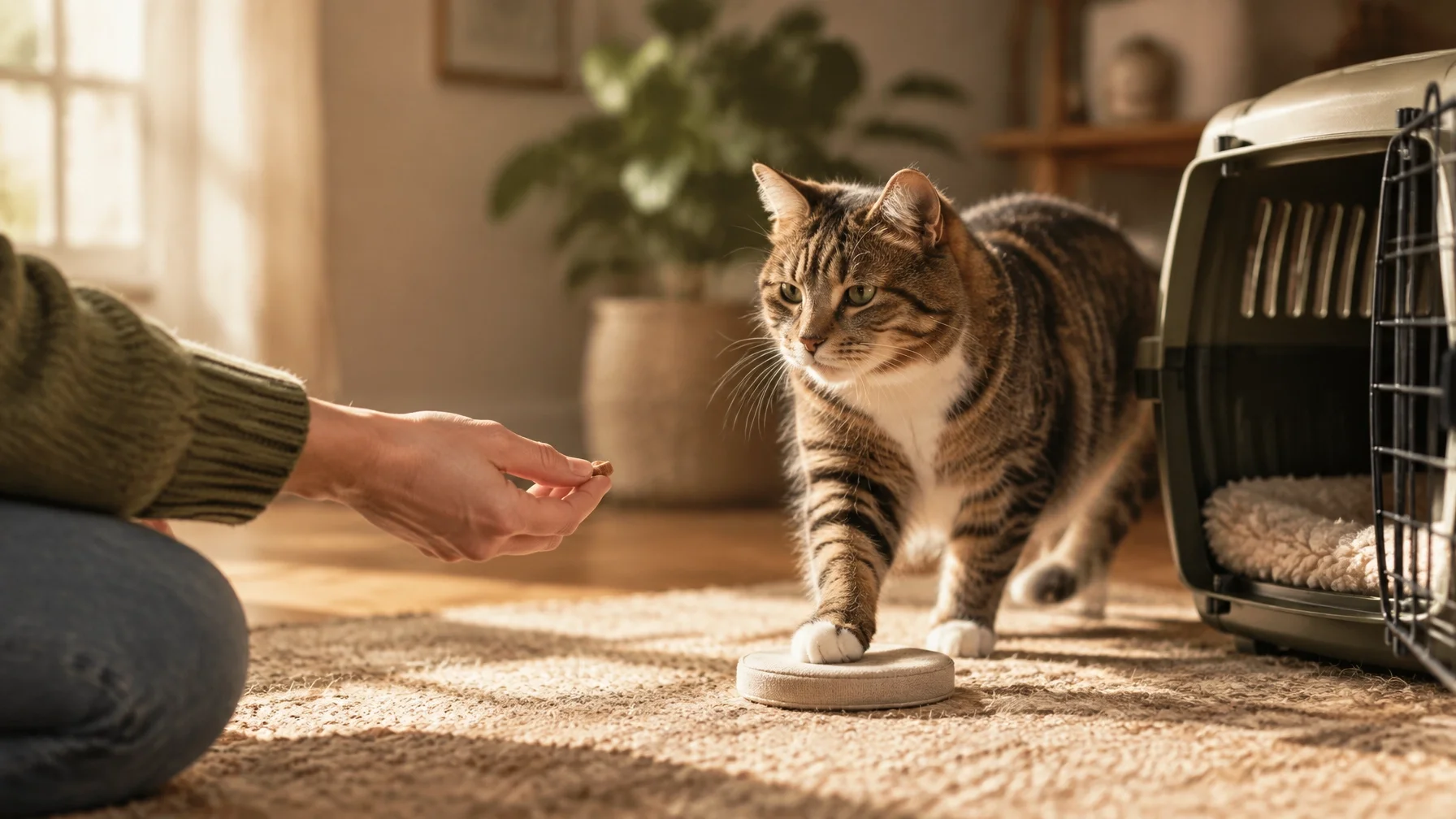
Training is about what happens before, during and after
A useful detective framework is:
Antecedent: What happens immediately before the behaviour?
Behaviour: What does the cat actually do?
Consequence: What happens immediately afterwards?
Imagine a cat who yowls at 4am.
The antecedent may be hunger, an active household, a learned breakfast routine or simply a cat who has become awake and socially motivated. The behaviour is vocalising. The consequence might be a person getting up, talking, feeding or opening a door.
From the cat’s perspective, the behaviour may be working beautifully.
This does not mean your cat is manipulating you. It means the behaviour has been reinforced. Behaviour that produces a meaningful outcome is more likely to happen again.
That same learning process can support:
Target training
Coming when called
Going to a mat or station
Voluntarily entering a carrier
Cooperative grooming and medication preparation
Voluntary harness practice
A recall cue that helps redirect night-time activity
In a study of 100 shelter cats, most learned to touch a target after short clicker-training sessions, with 79% mastering targeting and others learning behaviours such as spinning and high-fiving (Kogan et al., 2017). The point is not that every cat needs to perform tricks. The point is that cats can learn, and learning can make daily life safer, calmer and more predictable.
“Cats can’t be trained” is a myth
This myth is not your failure. It usually comes from comparing cats with dogs, expecting immediate compliance or defining training as obedience.
Cats often learn differently because their motivations, social relationships and communication styles differ. A cat may not rush over because you called their name, but that does not mean they are incapable of learning. It may mean:
The reward is not valuable to them.
The environment is too distracting.
The behaviour has not been broken into small enough steps.
They are worried, uncomfortable or in pain.
The cue has not been consistently paired with a useful outcome.
They have learned that approaching a person predicts something unpleasant.
Cats are also individuals. Research on feline cognition shows that cats are capable of learning, memory and problem-solving, while also highlighting the importance of studying each cat as an individual rather than expecting one universal response (Vitale Shreve & Udell, 2015).
This is why “cat whisperer” advice can be so unhelpful when it promises a magical shortcut. We do not need to mystify cats. We need to observe them carefully.
Why dominance-based training misses the real clue
Dominance-based advice asks, “How do I make my cat comply?”
A cat-centred approach asks:
What is my cat communicating?
What need is the behaviour meeting?
What can we change in the environment?
What alternative behaviour would be easier and more rewarding?
How can we give the cat a safe way to participate?
Punishment may suppress a behaviour in the moment, but it does not necessarily change the emotion or need underneath it. Shouting, spraying water, chasing, scruffing or forcing a cat into a carrier can make the person, room or object feel less safe.
That has consequences for the relationship. A cat who learns that a person predicts frightening handling may hide more, avoid interaction or escalate to defensive behaviour. This is especially relevant for veterinary care, grooming and medication.
Cat-friendly veterinary guidelines emphasise reducing fear, allowing cats to cope at their own pace and using gentle, low-stress interactions (Rodan et al., 2022). Choice is not permissiveness. It is a practical way to create cooperation.
The PAWS lens: four foundations for useful training
At The PAWS Approach, we use four connected foundations to investigate behaviour and design support.
P, Predictability
Cats cope better when they can anticipate what happens next.
We can make training more predictable by:
Using the same short cue.
Training at a similar time of day.
Keeping sessions brief.
Ending while the cat is still comfortable.
Pairing handling with familiar rewards.
Predictability does not mean making every day identical. It means reducing unnecessary surprises.
A, Agency
Agency means your cat has meaningful choices and can influence what happens to them.
A cat may choose to:
Approach a target.
Step onto a mat.
Enter a carrier.
Participate in a brief touch.
Move away and return later.
If your cat walks away, that is information, not insubordination. We can pause, lower the difficulty and make the next attempt easier.
W, Welfare
Training cannot be separated from physical and emotional wellbeing.
A sudden change in behaviour, new aggression, unusual vocalisation, reluctance to jump, hiding or changes in eating and toileting should prompt a veterinary check. Pain, illness, sensory changes and age-related conditions can all affect behaviour.
A behaviour plan works best alongside veterinary care, not instead of it. Location and behaviour clues are starting points for investigation, not diagnoses.
Enrichment also matters. Many indoor cats do not receive enough opportunity to express natural behaviours such as exploring, scratching, climbing, foraging and completing the predatory play cycle. Training can become one small form of enrichment, alongside environmental changes recommended in feline welfare guidelines (Ellis, 2009; Ellis et al., 2013).
S, Security
Security is the feeling that the environment is safe enough to investigate.
A secure cat is more likely to learn. That might mean:
A quiet training area.
A high resting place nearby.
A carrier left open as ordinary furniture.
A non-slip mat.
No looming hands or forced restraint.
A clear way to leave.
Training is not a test of obedience. It is a conversation where we make the helpful choice easier to understand.
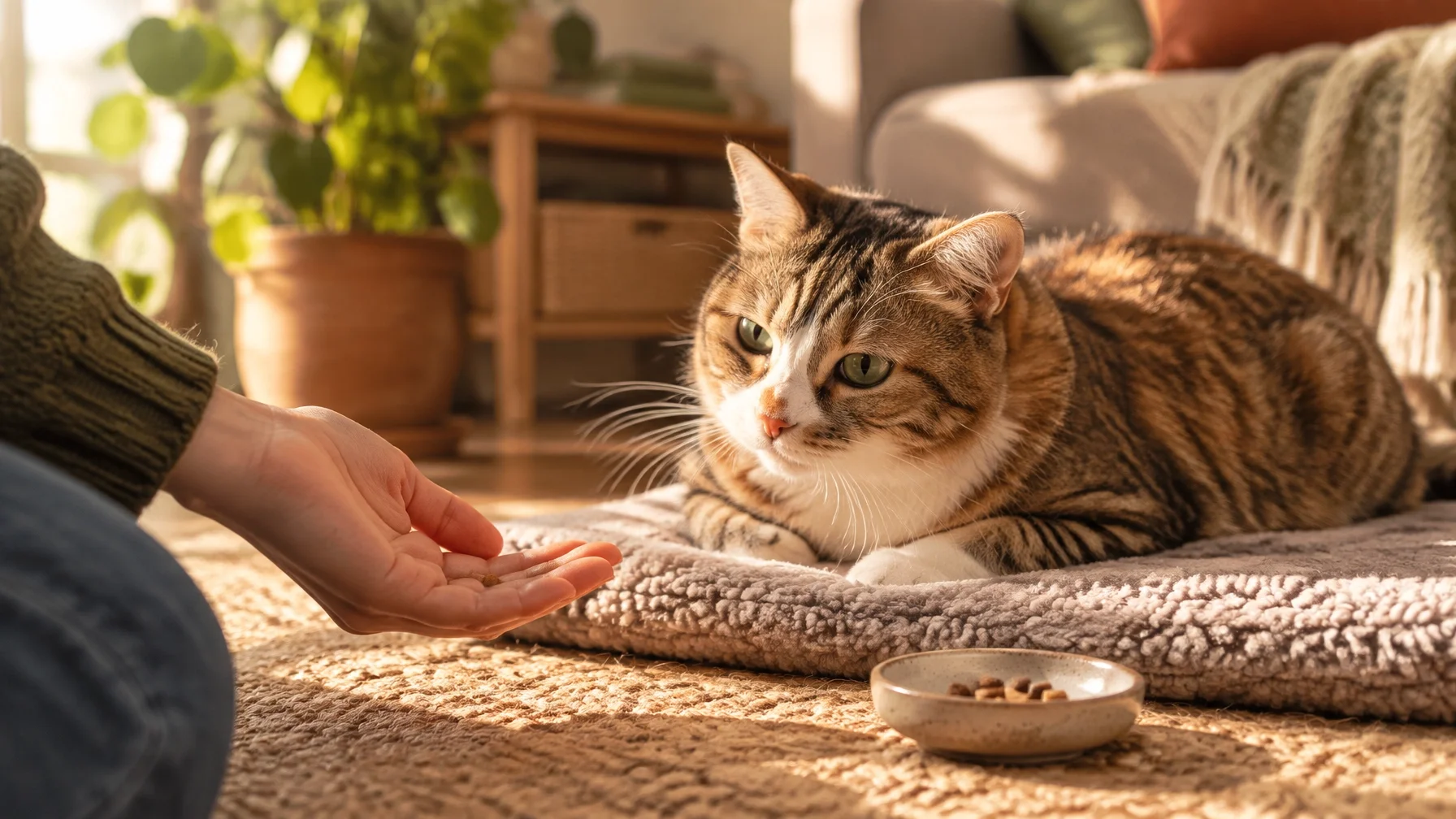
A fictional case: The Case of the Vanishing Carrier Cat
Let us meet Miso, a fictional three-year-old tabby whose family described her as “impossible to train”.
Miso vanished whenever the carrier appeared. Her family had tried chasing her, lifting her quickly and leaving the carrier hidden until vet day. Each attempt made sense in a stressful moment, but it also taught Miso that the carrier predicted a frightening scramble.
The family began again with a behaviour consultant and their veterinarian.
They:
Left the carrier open in a quiet room with the door secured safely open.
Rewarded Miso for looking at it, then approaching it.
Placed familiar bedding inside.
Reinforced one paw inside, then two.
Allowed Miso to leave after each step.
Practised closing the door for one second only after she was voluntarily entering.
Built duration gradually, pairing the carrier with food and calm experiences.
They also taught a stationing behaviour on a mat. The mat gave Miso a predictable place to settle while her family prepared food, packed medication or moved around the room.
There was no wrestling match. No dominance display. No demand that Miso “submit”.
The real win was not simply getting Miso into the carrier. It was helping her learn that the carrier was understandable, controllable and not an ambush.
Kittens, adults and seniors: the same principles, different needs
Kittens benefit from gentle, positive exposure to people, handling, household sounds and travel during early development. Experiences should be gradual and paired with safety, rather than overwhelming the kitten. Research into kitten socialisation shows that thoughtful additional socialisation can influence later behaviour and suitability as a companion (Casey & Bradshaw, 2008).
Older cats can learn too. However, pain, arthritis, hearing or vision changes and cognitive decline may alter how they respond. A senior cat may need:
Lower targets.
Softer surfaces.
More time to process cues.
Shorter sessions.
Fewer repetitions.
A veterinary assessment before training begins.
The question is not, “Why can’t this cat do it?” It is, “What adjustment would make this achievable and comfortable?”
Three gentle steps to start today
1. Choose one tiny behaviour
Try rewarding your cat for looking toward you, approaching a target or placing one paw on a mat. Keep the session to a few repetitions and stop while your cat is still interested.
2. Find your cat’s preferred reinforcer
A reward might be a tiny food treat, play, access to a favourite perch or gentle social interaction. Individual cats have individual preferences, and research confirms that these preferences vary (Vitale Shreve et al., 2017).
3. Replace “stop” with “what would we like instead?”
If your cat scratches the couch, consider where a suitable scratching surface could go. If they rush the kitchen at dawn, plan a predictable alternative routine. If they avoid the carrier, begin with the carrier simply existing nearby.
At The PAWS Approach, we provide cat behaviour consulting in Canberra and Queanbeyan, plus online consultations across Australia. We can investigate the environment, body language, routines and learning history, then create a written plan that complements your veterinarian’s care.
You can book a free 15-minute discovery call with no commitment, or call (+61) 02 4062 0105.
References
Bradshaw, J. W. S. (2018). Normal feline behaviour: … and why problem behaviours develop. Journal of Feline Medicine and Surgery, 20(5), 411–421. https://doi.org/10.1177/1098612X18771203
Casey, R. A., & Bradshaw, J. W. S. (2008). The effects of additional socialisation for kittens in a rescue centre on their behaviour and suitability as a pet. Applied Animal Behaviour Science, 114(1–2), 196–205. https://doi.org/10.1016/j.applanim.2008.01.003
Ellis, S. L. H. (2009). Environmental enrichment: Practical strategies for improving feline welfare. Journal of Feline Medicine and Surgery, 11(11), 901–912. https://doi.org/10.1016/j.jfms.2009.09.011
Ellis, S. L. H., Rodan, I., Carney, H. C., Heath, S., Rochlitz, I., Shearburn, L. D., Sundahl, E., & Westropp, J. L. (2013). AAFP and ISFM feline environmental needs guidelines. Journal of Feline Medicine and Surgery, 15(3), 219–230. https://doi.org/10.1177/1098612X13477537
Kogan, L., Kolus, C., & Schoenfeld-Tacher, R. (2017). Assessment of clicker training for shelter cats. Animals, 7(10), Article 73. https://doi.org/10.3390/ani7100073
Rodan, I., Dowgray, N., Carney, H. C., Carozza, E., Ellis, S. L. H., Heath, S., Niel, L., St Denis, K., & Taylor, S. (2022). 2022 AAFP/ISFM cat friendly veterinary interaction guidelines: Approach and handling techniques. Journal of Feline Medicine and Surgery, 24(11), 1093–1132. https://doi.org/10.1177/1098612X221128760
Vitale Shreve, K. R., Mehrkam, L. R., & Udell, M. A. R. (2017). Social interaction, food, scent or toys? A formal assessment of domestic pet and shelter cat preferences. Behavioural Processes, 141, 322–328. https://doi.org/10.1016/j.beproc.2017.03.016
Vitale Shreve, K. R., & Udell, M. A. R. (2015). What’s inside your cat’s head? A review of cat cognition research past, present and future. Animal Cognition, 18(6), 1195–1206. https://doi.org/10.1007/s10071-015-0897-6