
Is My Cat Stressed? The Signs We Often Miss (And What They're Telling You)
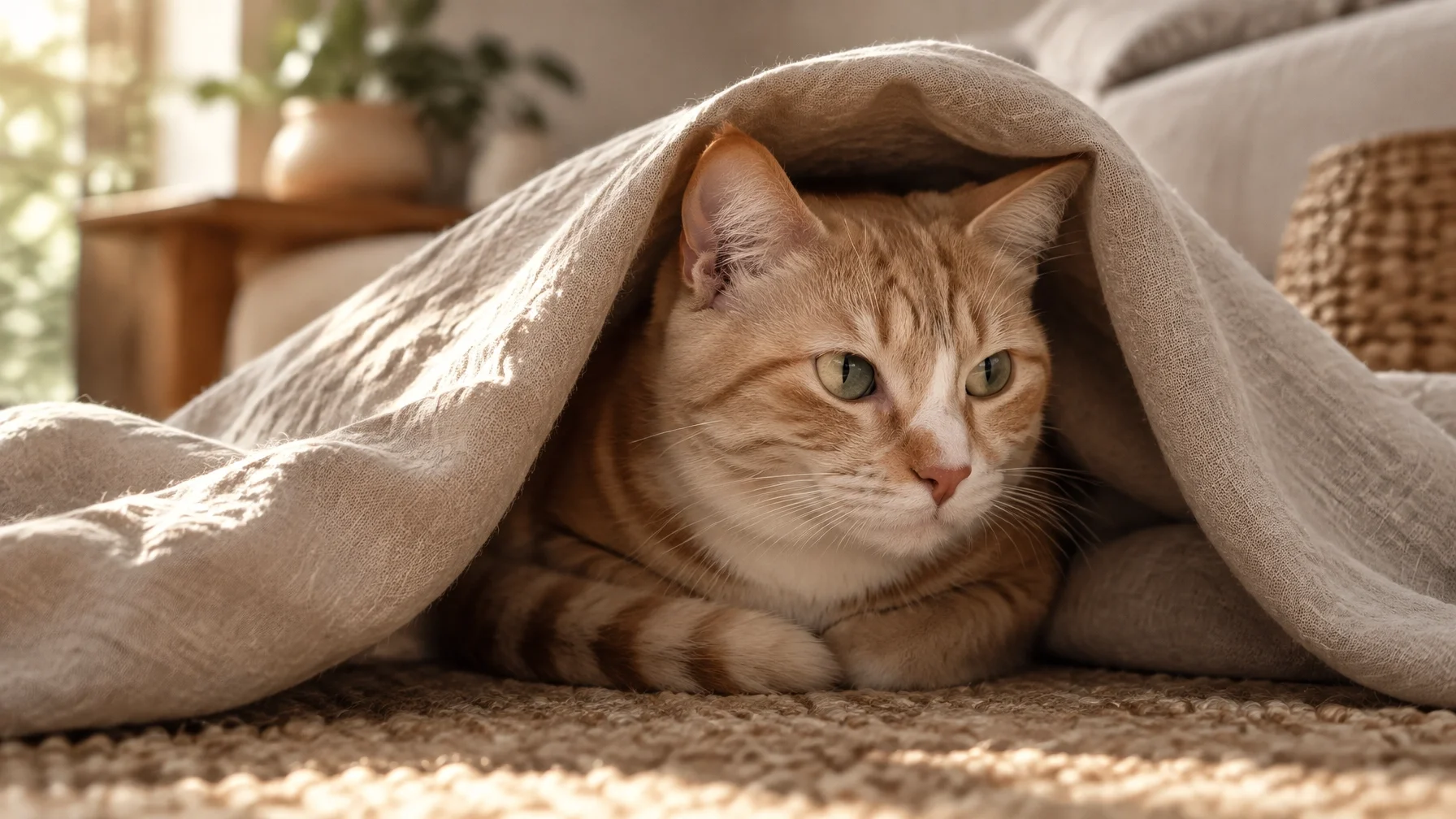
If you have searched “is my cat stressed?” because your cat is hiding more, grooming one patch, sitting with their tail wrapped tightly around their body, eating differently or startling at ordinary household sounds, you are already doing something important: you are noticing.
That is not overreacting. It is attentive ownership.
Cats are masters of subtlety and suppression. In the wild, looking vulnerable can be risky, so many cats reduce activity, hide discomfort or quietly alter their routines long before they show an obvious “problem behaviour”. Research on owned cats describes stress-related changes in activity, grooming, social interaction, elimination and vigilance that can be easy to overlook in everyday life (Amat et al., 2016).
Stress is common. It is not your fault. And it is often fixable with the right investigation and support.
The escalation path: from tiny clue to crisis
A subtle change does not automatically mean your cat is stressed. But patterns matter.
The pathway may look like this:
Small sign → ignored → worsens → suppressed → crisis
For example:
Your cat hides for an extra hour each day.
The change is dismissed as “just being a cat”.
They stop exploring and become more vigilant.
They suppress normal behaviours such as play, grooming or social contact.
Eventually, the household is facing over-grooming, house-soiling, withdrawal, escalating vet bills or pressure to consider relinquishment.
This is not a reason to panic. It is a reason to investigate early, while your cat still has more emotional and physical capacity to cope.
What is happening inside the cat?
Stress is not simply a mood. It involves the nervous system, hormones, behaviour and the cat’s perception of safety.
A worried cat may:
scan the room more often
startle at noises they previously ignored
keep their body low or tense
hide or face away
reduce movement to conserve energy
groom more, less or in a very focused area
change their eating, drinking or toileting routine
avoid jumping, climbing or social contact
These signs can also indicate pain or illness. That overlap is why we never treat “stress” as a diagnosis.
Pain, dental disease, hyperthyroidism, chronic kidney disease, arthritis, sensory decline can all alter a cat’s behaviour. Reduced jumping is particularly important to discuss with a vet because mobility and lifestyle changes are recognised signs in cats with musculoskeletal disease (Bennett & Morton, 2009).
Stress and environmental factors can influence urinary signs and recurrence, but urinary changes always deserve veterinary attention. Environmental modification has been associated with improved outcomes for some cats with idiopathic cystitis (Buffington et al., 2006). If litter tray changes or urinary signs are part of the picture, our post on cat peeing outside the litter box may help you investigate those clues more clearly.
The signs below are starting points for investigation, not diagnoses. A veterinary work-up plus a full behaviour assessment is needed.
The PAWS investigation: Predictability, Agency, Welfare and Security
We use four connected questions to understand what a cat may be communicating.
1. Predictability: has the world become harder to anticipate?
Cats often cope better when important parts of life are consistent. Look for changes such as:
hiding after household noise, visitors or building work
sleeping in a different location
waiting before entering a room
eating only when the house is quiet
becoming more watchful around another cat
reacting strongly to sounds, movement or handling
A predictable routine does not mean a rigid household. It means your cat can anticipate what happens next and has enough warning to make choices.
Helpful starting points may include:
keeping meals and medication routines reasonably consistent
providing quiet transition spaces during busy periods
reducing sudden approaches and loud, unavoidable interruptions
giving your cat a clear route between resting, eating, toileting and retreat areas
In multi-cat households, predictability also means considering whether one cat can pass through the home without being blocked, followed or watched. If you are unsure whether the tension you are seeing is playful or more pressured, our guide to is this cat play or fighting? can help you read those interactions more carefully.
2. Agency: can your cat opt in or opt out?
A cat who sits facing away, turns their head during touch or leaves when approached may be communicating, “Not right now.”
That is valuable information, not rudeness.
We can support agency by:
offering a hand for your cat to investigate rather than reaching over them
pausing when ears rotate, the body stiffens or the tail tightens
allowing the cat to approach and leave freely
avoiding forced cuddles, restraint or repeated attempts to “cheer them up”
rewarding voluntary participation in handling and cooperative care
Fear-free interaction guidelines emphasise reading feline body language, minimising restraint and adapting handling to the individual cat (Rodan et al., 2022).
Agency is not permissiveness. It is giving your cat a safe way to communicate before they need a louder one.
3. Welfare: are basic needs becoming difficult to meet?
A stressed cat may still eat, use the litter tray and appear affectionate. That does not necessarily mean they are comfortable.
Look at the whole daily experience:
Can your cat rest without being disturbed?
Are food, water and litter resources easy to access?
Is the litter tray private but not trapped in a dead-end location?
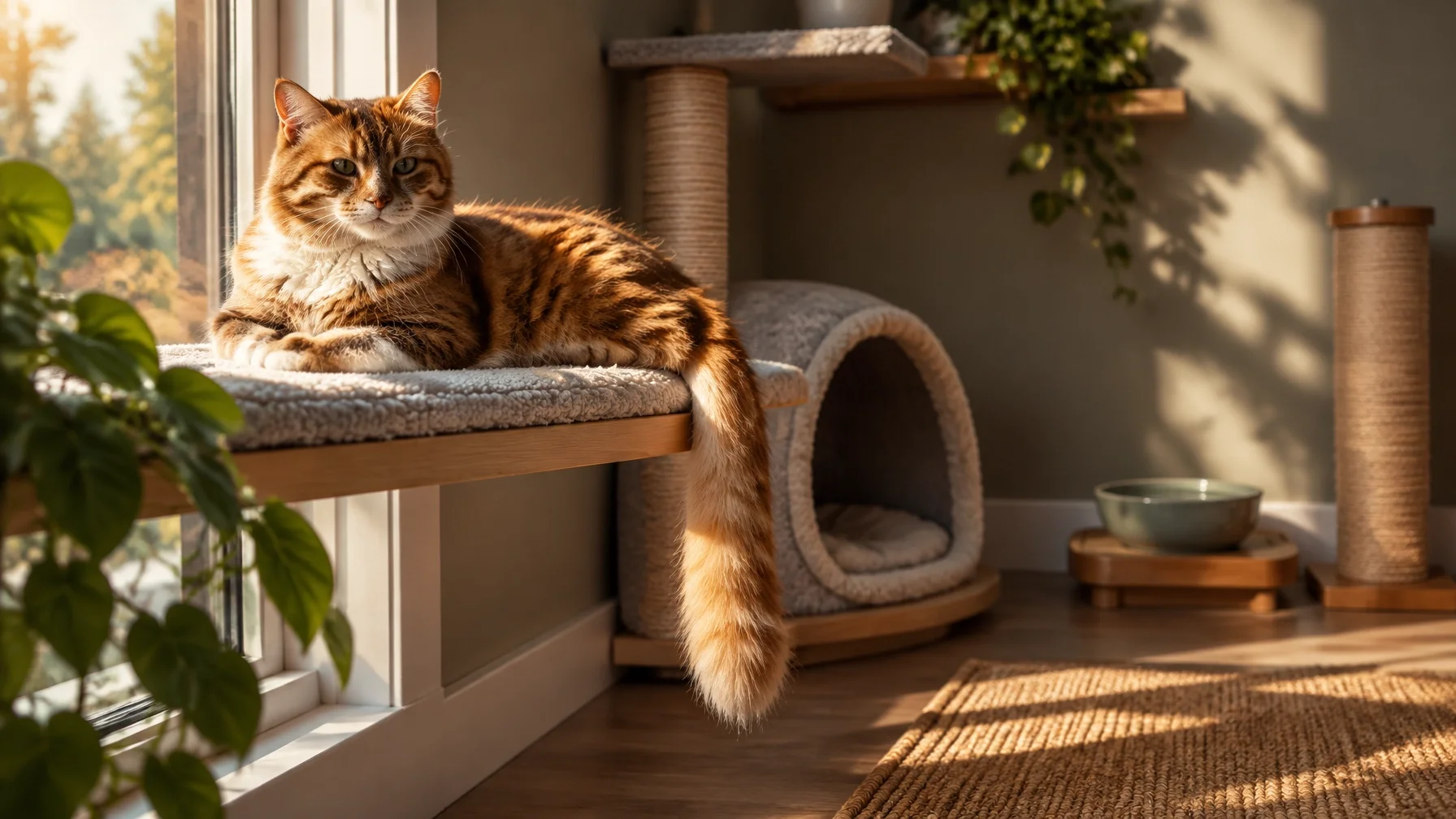
Are there elevated spaces and covered hiding places?
Can your cat scratch, observe and retreat?
Does grooming look normal for this individual?
Has play or exploration reduced?
Play is only one piece of the puzzle, but a sudden reduction can be informative. If your cat is interested, we can offer short, low-pressure opportunities that follow the predatory sequence of stalk, chase, pounce and catch. Some cats need to rediscover play gradually, especially when pain, fear or low confidence has interrupted it. If that sounds familiar, our post on why doesn’t my cat play anymore? explores what reduced play can be telling us.
The AAFP/ISFM environmental needs guidelines recommend supporting feline needs for safe places, separated resources, opportunities for play and predatory behaviour, positive human interaction and a consistent environment (Ellis et al., 2013).
4. Security: does your cat have somewhere safe to be a cat?
Security is more than having a hiding place. It is having a refuge where your cat is unlikely to be cornered, grabbed or surprised.
A secure setup may include:
a covered bed or box with more than one exit
a high resting place with a stable surface
visual barriers from dogs, children, windows or other cats
quiet access to food, water and litter
a calm pathway between important resources
people who notice “no” and respond respectfully
The aim is not to make your cat interact more. It is to make interaction feel safer when they choose it.
The Case of the Cat Who Ate Facing the Wall
Let us consider a fictional case.
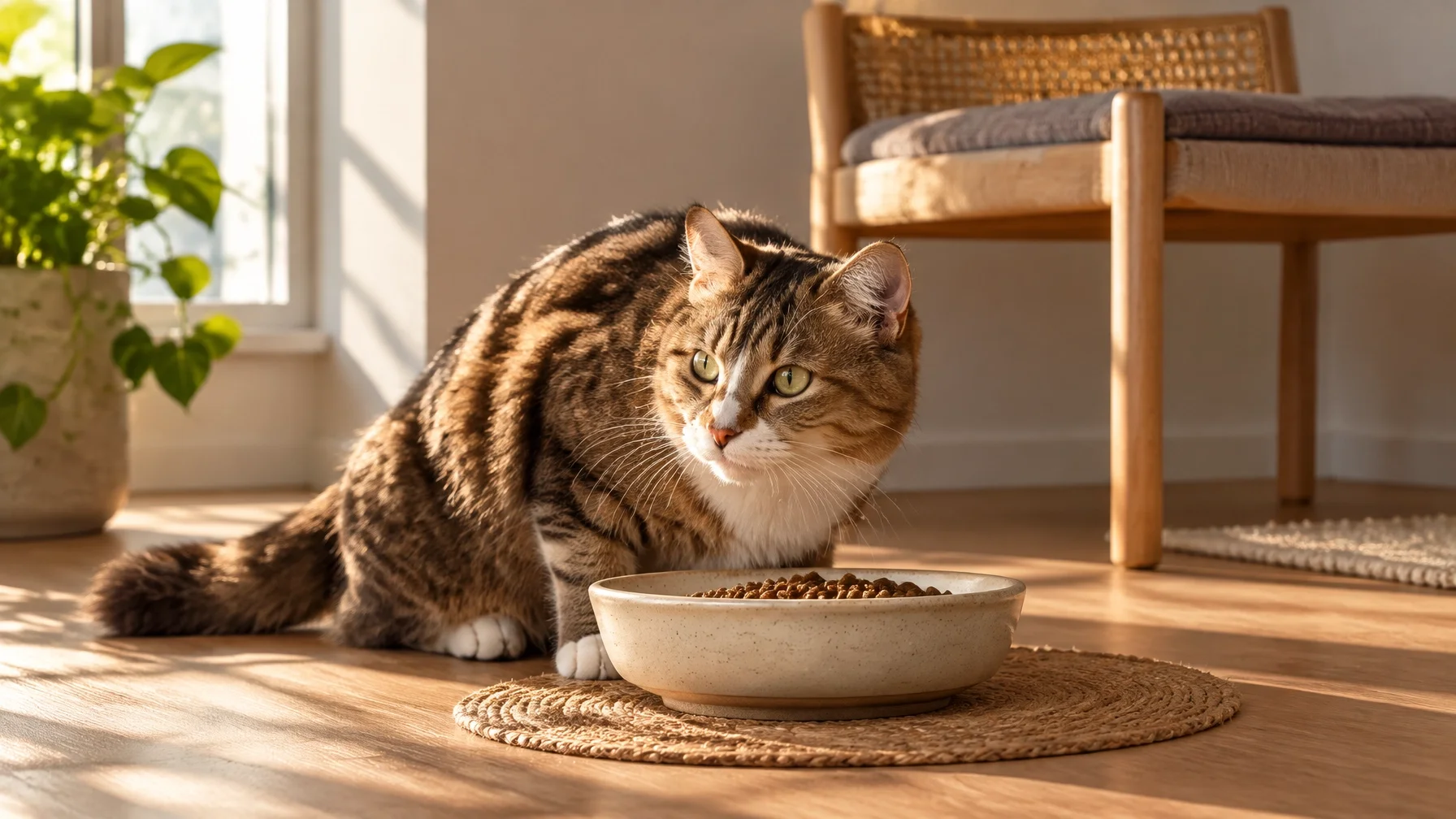
Milo’s family initially described him as “fine, just a bit odd lately”. He was still eating, but he had started positioning himself with one shoulder pressed towards the wall while he ate. His coat looked slightly dull. He jumped onto the sofa less often, sat with his tail wrapped tightly around his paws and startled when someone closed a cupboard.
His family had not caused this. In fact, they had already done something excellent: they had noticed a cluster of small changes.
The veterinary work-up came first. Milo had mild dental discomfort and early arthritis changes that could help explain the reduced jumping and guarded posture. His family and vet then considered environmental stress alongside treatment.
During a behaviour assessment, we looked at:
where Milo ate and whether he could see approaching people
the height and stability of his resting places
household noise patterns
his preferred distance from family members
how the other cat moved through shared spaces
whether he could retreat without being followed
The plan did not demand that Milo become a lap cat or return to his old routines immediately. His food station was moved to a quieter position with a clear view of the room. A lower, easier resting option was added beside his favourite window perch. His family began offering touch by invitation and paused earlier when he showed signs of tension.
Over time, Milo ate with a more open posture and chose the room more often. He still preferred peaceful observation to constant interaction. His family learned that this was not failure. It was choice.
The outcome was not a fairytale cure. It was a more comfortable, more predictable life in which Milo could participate without having to suppress himself.
What you can do today
Please consider keeping a brief observation log for several days:
What changed?
When did it begin?
Where does it happen?
What occurs immediately beforehand?
What does your cat do next?
Are eating, drinking, toileting, grooming or movement different?
Does your cat recover quickly, or remain guarded?
Then contact your vet, particularly if you notice urinary changes, reduced appetite, pain, marked withdrawal, repeated vomiting, mobility changes or a sudden behaviour shift.
The PAWS Approach works alongside veterinary care, never instead of it. With your consent, we can liaise directly with your vet so medical information and behaviour observations inform the same plan.
If you are worried but unsure what the first step should be, you are welcome to book a low-pressure, free 15-minute Discovery Call at thepawsapproach.au/book. There is no commitment. You can simply describe what you have noticed, ask questions and explore whether support would be useful.
We provide in-person support in Canberra and Queanbeyan, with online consultations available elsewhere in Australia. You can also call us on (+61) 02 4062 0105.
Noticing is not a sign that you have failed your cat. It is often the moment you begin advocating for them.
A free guide for curious cat people
Sign up and receive The PAWS Approach’s free guide, Why Do Cats “Cat”?
References
Amat, M., Camps, T., & Manteca, X. (2016). Stress in owned cats: Behavioural changes and welfare implications. Journal of Feline Medicine and Surgery, 18(8), 577–586. https://doi.org/10.1177/1098612X15590867
Bennett, D., & Morton, C. (2009). A study of owner-observed behavioural and lifestyle changes in cats with musculoskeletal disease before and after analgesic therapy. Journal of Feline Medicine and Surgery, 11(12), 997–1004. https://doi.org/10.1016/j.jfms.2009.09.016
Buffington, C. A. T., Westropp, J. L., Chew, D. J., & Bolus, R. R. (2006). Clinical evaluation of multimodal environmental modification in the management of cats with idiopathic cystitis. Journal of Feline Medicine and Surgery, 8(4), 261–268. https://doi.org/10.1016/j.jfms.2006.02.002
Ellis, S. L. H., Rodan, I., Carney, H. C., et al. (2013). AAFP and ISFM feline environmental needs guidelines. Journal of Feline Medicine and Surgery, 15(3), 219–230. https://doi.org/10.1177/1098612X13477537
Rodan, I., Sundahl, E., Carney, H., Gagnon, A.-C., Heath, S., Landsberg, G., Seksel, K., & Yin, S. (2022). 2022 AAFP/ISFM Cat Friendly Veterinary Interaction Guidelines: Approach and handling techniques. Journal of Feline Medicine and Surgery, 24(11), 1093–1132. https://doi.org/10.1177/1098612X221128760
Stella, J. L., Croney, C. C., & Buffington, C. A. T. (2013). Effects of stressors on the behaviour and physiology of domestic cats. Applied Animal Behaviour Science, 143(2–4), 157–163. https://doi.org/10.1016/j.applanim.2012.10.014