
Do My Cats Actually Like Each Other? How to Read Your Cats' Relationship
You’re already doing something very important: you’re paying attention.
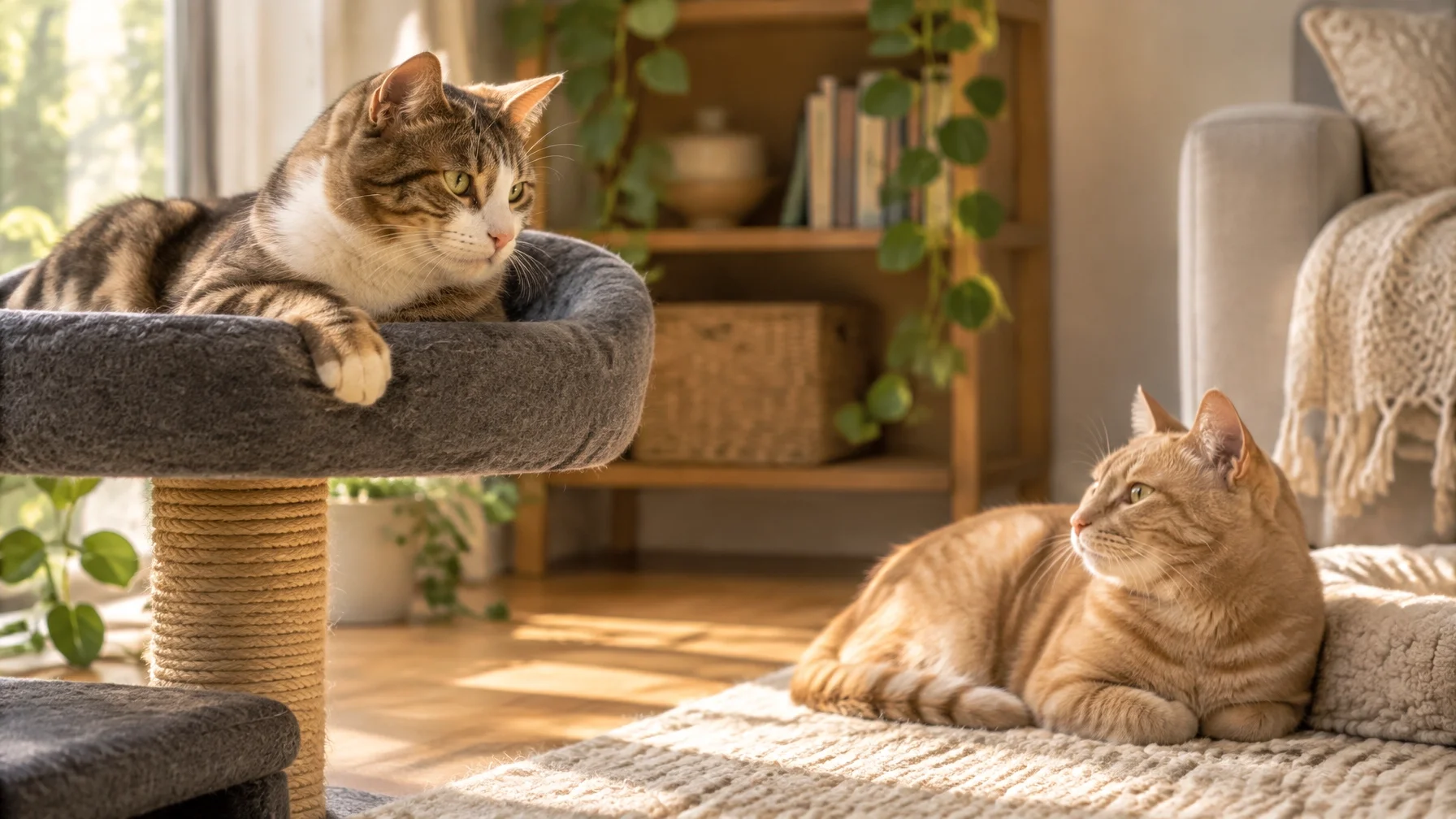
Perhaps you’ve searched “do my cats actually like each other?”, “are my cats happy together?”, or “my cats ignore each other” after noticing that your cats share a home but not a cuddle puddle. Maybe they were inseparable kittens who have quietly drifted apart. Maybe they have never fought, but one cat always seems to leave when the other enters the room.
Take a breath. This is common. It is not proof that you have failed your cats, and it is often workable.
The detective clue is that cats can share a postcode without sharing a social bond. Let’s investigate what their relationship may actually look like.
Cats do not all want the same kind of friendship
Domestic cats are socially flexible rather than socially obligate. Some enjoy close relationships with selected cats. Others prefer a generous buffer zone and a peaceful arrangement. Many cats can live successfully as housemates without becoming best friends (Finka, 2022; Rodan et al., 2024).
In cat terms, friendship may involve:
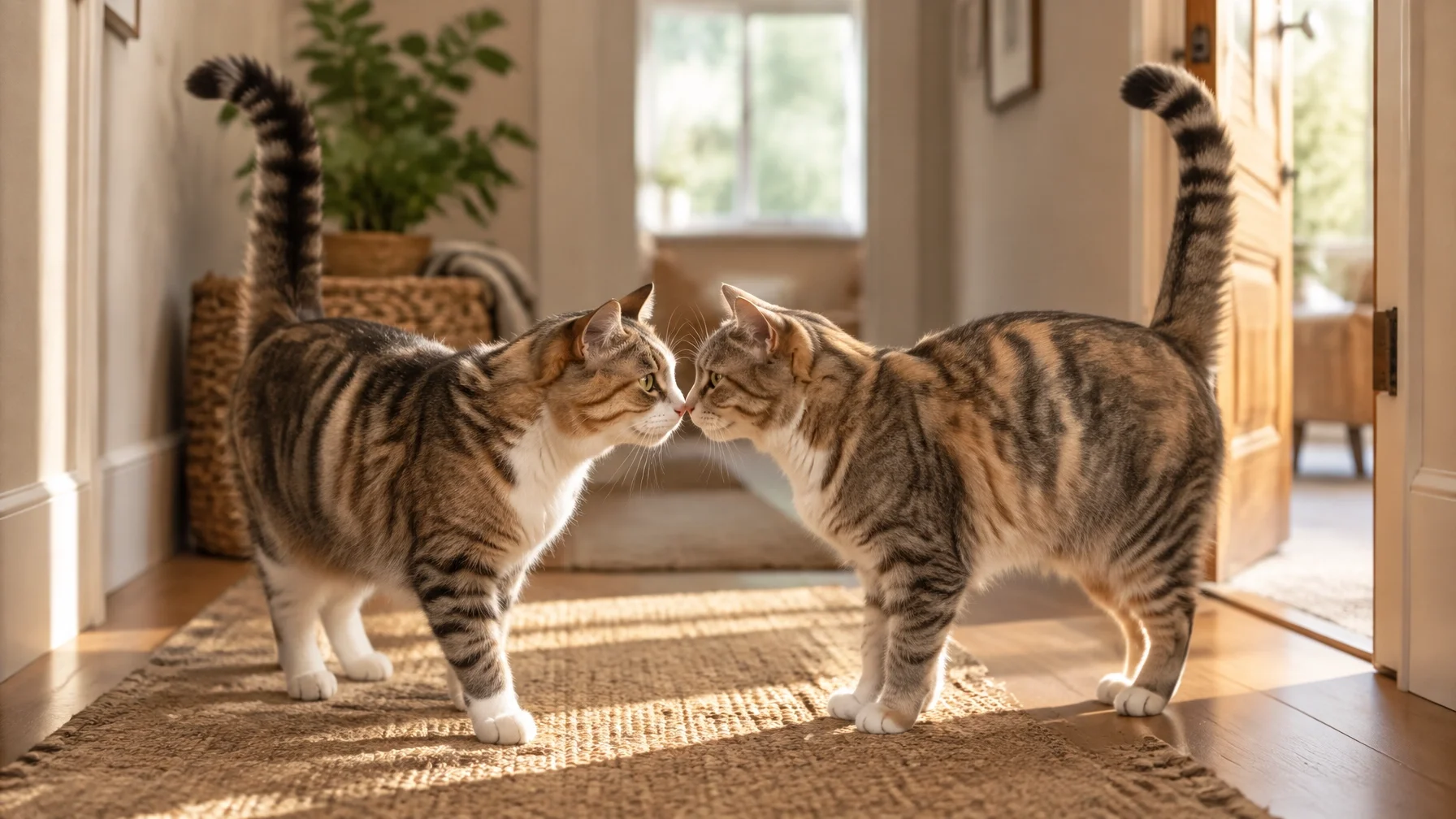
Approaching with a relaxed, upright tail.
Nose touches or gentle sniffing.
Allorubbing: rubbing faces or bodies together.
Allogrooming: grooming one another, usually around the head and neck.
Sleeping in contact or choosing close proximity.
Relaxed play invitations, with both cats able to pause or leave.
Soft eyes, relaxed ears and occasional slow blinking.
A cat who chooses to be near another cat is giving us useful information. But proximity alone is not a complete verdict. Two cats may be sitting on the same bed because it is the best bed in the house, while carefully occupying opposite ends and facing away from each other.
That may be tolerance, not friendship.
The relationship spectrum: from bonded to uneasy
Rather than asking, “Do they like each other: yes or no?”, we can map the relationship across a spectrum.
1. Socially bonded
These cats actively seek each other out. You may notice:
Frequent nose touches, rubbing or tail-up greetings.
Mutual or repeated grooming.
Sleeping curled together or touching.
Relaxed shared time that appears voluntary.
Neither cat needing to retreat when the other approaches.
This is the feline equivalent of choosing the same café table when there are twenty empty tables available.
2. Comfortable tolerance
These cats are not especially affectionate, but they can move through the home without social pressure. They may:
Rest in the same room at a comfortable distance.
Time-share favourite resources.
Pass each other without staring, chasing or blocking.
Choose separate beds, shelves or rooms.
Show relaxed body language when they notice one another.
This is a perfectly acceptable outcome. Peaceful coexistence does not require matching friendship bracelets.
3. Uneasy co-existence
Here, one or both cats are adjusting their behaviour to avoid the other. Look for:
One cat always moving away when the other arrives.
A cat waiting before entering a room.
Sleeping locations changing over time.
Reduced play or exploration.
Avoidance of certain hallways, doorways or rooms.
Eating quickly and leaving, or waiting until the other cat has finished.
Hiding more often than usual.
There may be no dramatic fight. The relationship is still giving us clues.
4. Chronic low-grade tension
This is where we become especially interested. Warning signs can include:
Hard staring or prolonged visual fixation.
Blocking doorways, stairs, food bowls or litter trays.
Resource guarding.
One cat controlling a pinch point, such as a narrow hallway.
Repeated stalking or following.
Hissing, growling, swatting or chasing.
Redirected aggression after an outdoor cat, noise or stressful event.
Over-grooming, house-soiling, appetite change or weight change.
The 2024 AAFP Intercat Tension Guidelines emphasise that tension is often subtle. Staring, blocking, walking away and hiding can be just as important as overt conflict (Rodan et al., 2024).
Why sharing a home is not the same as sharing a relationship
Here is the biological plot twist: cats evolved as solitary hunters, but they can form flexible social groups when resources are available. Within those groups, cats often choose preferred associates rather than treating every individual as a friend (Crowell-Davis et al., 2004).
In a home, however, humans choose the social arrangement. We decide which cats share a kitchen, hallway, litter area and sofa. The cats may have little control over who enters their core territory or whether they can leave an uncomfortable interaction.
That is why a shared food bowl or favourite couch can create misleading evidence. Cats may be time-sharing resources rather than enjoying them together. One cat uses the sunny chair in the morning; the other appears in the afternoon. From a human perspective, this may look harmonious. From the cat’s perspective, it may be a carefully negotiated timetable.
Relatedness and shared kittenhood can increase the likelihood of adult affiliation, but they do not guarantee permanent friendship. Cats change as they mature, and pain, illness, environmental changes or stressful experiences can alter a relationship (Curtis et al., 2003; Finka, 2022).
Please retire the “they’ll sort it out” theory
Cats generally have fewer reconciliation behaviours than many people expect. After tension, they may avoid, freeze, retreat or repel the other cat. They do not reliably hold a tiny household meeting, exchange apologies and agree to communicate better.
So, no: we do not recommend forcing cats together or leaving them to “work it out”. Repeated exposure to frightening interactions can make the emotional association stronger.
The escalation path may look like this:
> Small problem → ignored → avoidance → hidden stress → house-soiling, over-grooming, weight or appetite change → illness, burnout and pressure to rehome.
This is not a reason to panic. It is a reason to act early, while the clues are still small and the cats still have room to learn that the home can feel safe again.
A PAWS-friendly home audit
From the cat’s perspective, we can ask four useful questions.
Predictability
Can each cat anticipate where food, water and litter trays are?
Are routines reasonably consistent?
Are interactions calm and free from sudden forced contact?
Agency
Can each cat choose whether to approach, retreat or rest?
Are there escape routes rather than dead ends?
Can a cat leave a shared space without passing directly through another cat’s personal bubble?
Welfare
Does each cat receive individual attention?
Are there separate play sessions suited to each cat’s age, health and preferences?
Are changes in appetite, grooming, toileting or sleep being investigated?
Security
Does each cat have safe resting places and elevated vantage points?
Can another cat easily block access?
Are resources distributed across the home rather than clustered in one busy area?
In practical terms, we suggest considering:
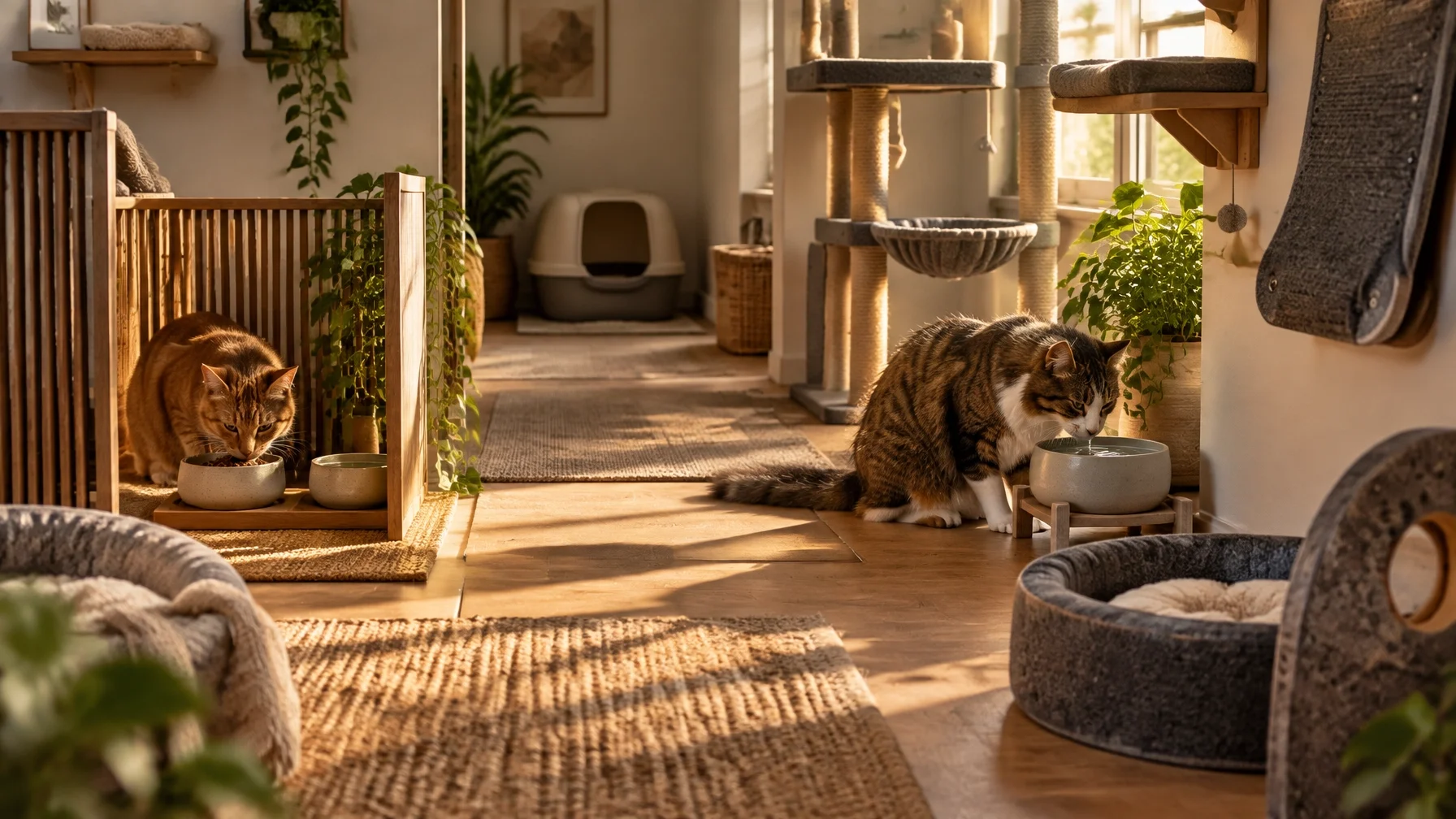
Litter trays: at least one per cat, plus one extra, positioned in separate quiet locations.
Feeding: separate feeding stations, ideally with visual separation.
Water: multiple water sources away from food and litter areas.
Resting places: beds, boxes, shelves and high perches at different heights.
Escape routes: more than one way in and out of important spaces.
Scratching areas: several surfaces placed throughout the cats’ territories.
Play: individual play opportunities, especially if one cat has a much higher play drive.
The five clues to look for this week
Rather than trying to judge the entire relationship from one interaction, keep a gentle observation log.
Who seeks whom out?
Note voluntary approaches, greetings and proximity.Who moves away?
Look for repeated retreating, waiting or route changes.Where are the pinch points?
Watch doorways, stairs, hallways and access to litter trays.What happens around resources?
Observe staring, rushing, guarding, waiting or leaving quickly.Does each cat still behave like themselves?
Track play, appetite, grooming, sleep, toileting and exploration.
You do not need to intervene in every mild interaction. A brief hiss or a cat choosing to walk away may be normal communication. We become more concerned when patterns are frequent, one-sided, escalating or associated with reduced access to normal activities.
Case file: The siblings who changed the timetable
Consider two fictional cats, Clover and Bramble, who arrived together as kittens. They used to sleep in a heap. By adulthood, they no longer groomed or rested together. Clover began waiting at the end of the hallway before approaching the litter area. Bramble was not chasing her every time; he simply sat near the doorway and watched.
Their family assumed the cats had “fallen out” and worried their bond was permanently broken.
A closer investigation revealed that the only litter trays were in one room, behind the hallway Bramble preferred to occupy. Clover was also being interrupted during meals and had stopped playing in the living room.
The first goal was not to make the cats cuddle again. It was to restore access, choice and security:
Additional trays were placed in separate locations.
Food stations were separated with a visual barrier.
Clover received a quiet elevated resting area.
Bramble was given individual play sessions.
The family stopped forcing shared time and began recording relaxed interactions.
Over time, Clover moved through the home more freely. Bramble no longer needed to monitor the hallway. They did not return to sleeping in a single furry knot, but they developed comfortable tolerance, occasional tail-up greetings and relaxed shared time.
That was a successful outcome.
And some cats genuinely are friends. Fictional cats Olive and Finch choose each other’s company, greet with upright tails, rub faces, groom one another and sleep touching even when separate beds are available. Their relationship is not created by humans placing them together. It is visible in their repeated, voluntary choices.
Vet, behaviourist or both?
Please arrange a veterinary assessment first if the relationship changes suddenly or if you notice:
New aggression or marked irritability.
Increased hiding.
House-soiling or urine marking.
Appetite or weight change.
Reduced movement or reluctance to jump.
Over-grooming or skin changes.
Changes in sleep, play or toileting.
Pain and illness can alter how a cat responds to housemates. A returning cat may also smell unfamiliar after a veterinary visit, temporarily disrupting an established relationship.
A cat behaviour consultant can then investigate the social map, resource access, environment, routines and body language. The PAWS Approach works alongside veterinary care, and we are happy to liaise directly with your vet when appropriate.
Please remember: location and substrate signals are starting points for investigation, not diagnoses. A cat choosing a particular room, surface or resource pattern cannot tell us the cause on its own. Veterinary and behavioural assessment may both be needed.
If you are puzzled, worried or exhausted, seeking help is not an admission of failure. It is permission to be the attentive, thoughtful cat guardian you are already trying to be.
We offer a free, low-pressure 15-minute discovery call with no commitment required. We can talk through what you are seeing, help you decide whether support is appropriate, and explain the next step if it is. We provide in-person consultations in Canberra and Queanbeyan, plus online consultations Australia-wide.
Book a free discovery call with The PAWS Approach.
References
Cafazzo, S., & Natoli, E. (2009). The social function of tail up in the domestic cat (Felis silvestris catus). Behavioural Processes, 80(1), 60–66. https://doi.org/10.1016/j.beproc.2008.09.008
Crowell-Davis, S. L., Curtis, T. M., & Knowles, R. J. (2004). Social organization in the cat: A modern understanding. Journal of Feline Medicine and Surgery, 6(1), 19–28. https://doi.org/10.1016/j.jfms.2003.09.013
Curtis, T. M., Knowles, R. J., & Crowell-Davis, S. L. (2003). Influence of familiarity and relatedness on proximity and allogrooming in domestic cats (Felis catus). American Journal of Veterinary Research, 64(9), 1151–1154. https://doi.org/10.2460/ajvr.2003.64.1151
Ellis, S. L. H., Rodan, I., Carney, H. C., Heath, S., Rochlitz, I., Shearburn, L. D., Sundahl, E., & Westropp, J. L. (2013). AAFP and ISFM feline environmental needs guidelines. Journal of Feline Medicine and Surgery, 15(3), 219–230. https://doi.org/10.1177/1098612X13477537
Finka, L. R. (2022). Conspecific and human sociality in the domestic cat: Consideration of proximate mechanisms, human selection and implications for cat welfare. Animals, 12(3), 298. https://doi.org/10.3390/ani12030298
Rodan, I., Ramos, D., Carney, H., DePorter, T., Horwitz, D. F., Mills, D., & Vitale, K. (2024). 2024 AAFP intercat tension guidelines: Recognition, prevention and management. Journal of Feline Medicine and Surgery, 26(7), Article 1098612X241263465. https://doi.org/10.1177/1098612X241263465