
Why Does My Cat Bite Me When I Pat Them? What Your Cat's "Love Bite" Is Trying to Tell You
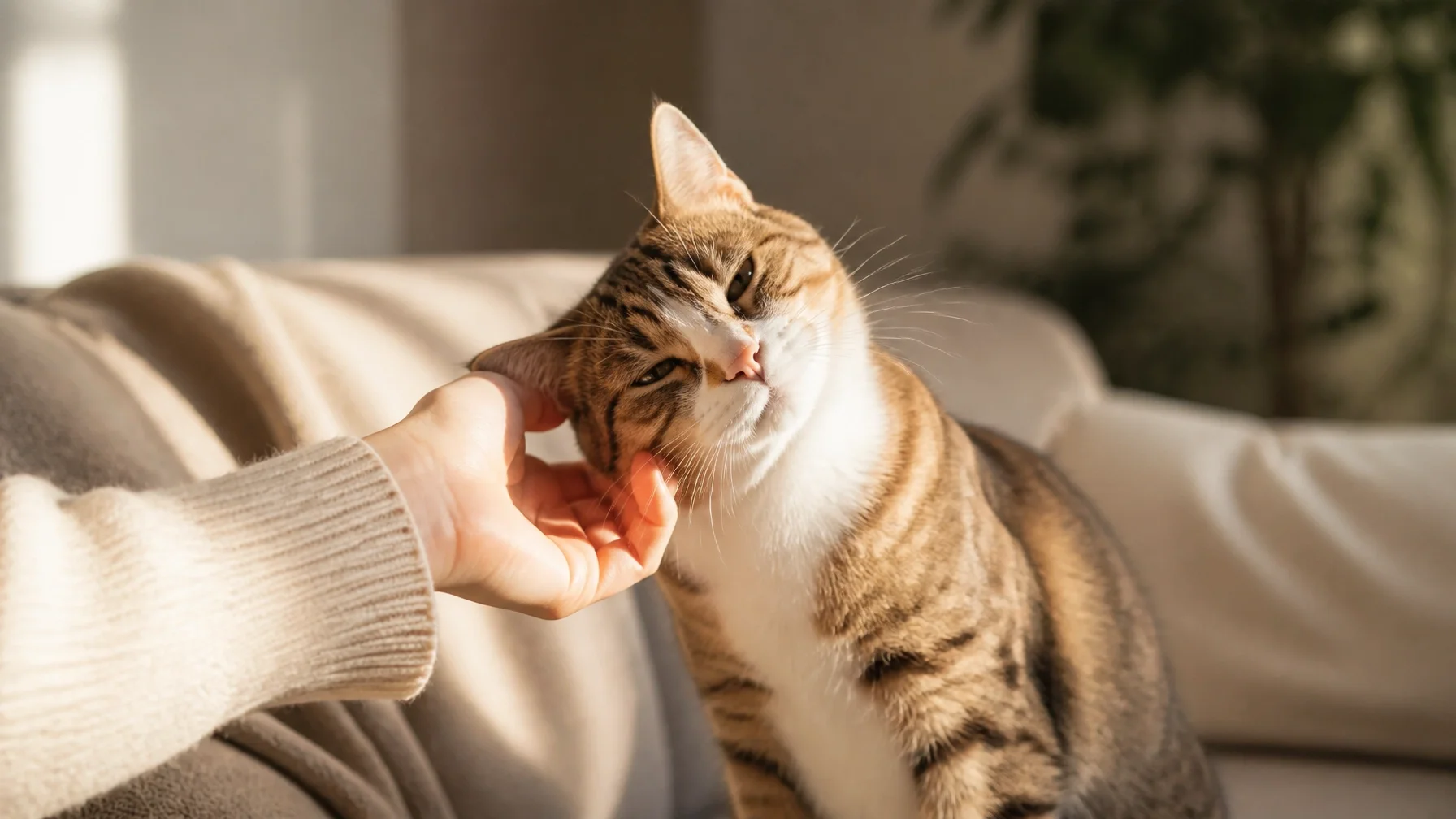
Your cat approaches, leans into a few pats, perhaps purrs like a tiny motor, and then suddenly turns around and bites. It is confusing, painful and capable of making you wonder whether your cat has secretly cancelled your friendship.
Please take a breath. Petting-induced biting is common, it does not mean your cat is mean, and it is not automatically your fault. In many cases, your cat is communicating that the interaction has crossed their comfort threshold.
The bite is a clue. Our job is to investigate what happened before it.
First clue: your cat may be saying “that’s enough”
Some cats genuinely enjoy being patted but have a limited tolerance for repeated touch. They may solicit contact, relax into it and then reach a point where the sensation becomes too intense, irritating or uncomfortable.
This is often called petting-induced aggression. Research and clinical guidance describe it as a context-dependent behaviour influenced by touch, location, duration, arousal, past learning and the cat’s ability to move away (Amat & Manteca, 2019; Fritz et al., 2022). Owner-reported research has also examined human-directed aggression in domestic cats, including the contexts and risk factors in which these bites and swats can occur (Ramos & Mills, 2009).
From your cat’s perspective, the sequence may look like this:
“I would like some contact.”
“That feels pleasant.”
“The sensation is becoming too much.”
“I need this to stop.”
“My quieter signals have not worked, so I’ll use my teeth.”
That final step can feel sudden to us, but the bite may be the end of a longer conversation.
The biological “why”: tactile overload and approach-withdrawal conflict
Cats experience touch through a highly sensitive sensory system. Repetitive stroking over the same area can gradually increase arousal. A sensation that began as pleasant may become irritating, particularly if your cat cannot easily change position or leave. If hands have accidentally become part of play, excitement and touch can become muddled, so play should always involve a toy rather than hands. You can learn more in our guide to why cats stop playing.
This can create an approach-withdrawal conflict:
Your cat wants the social contact.
Your cat also wants control over how long it lasts.
The desire for contact and the desire to escape can exist at the same time.
That is why a cat may climb onto your lap, ask for pats and still bite thirty seconds later. They have not necessarily changed their mind about you. Their body has reached its limit.
The location of touch can also matter. Many cats prefer contact around the cheeks, chin, forehead and areas near the ears. Others enjoy different forms of touch. There is no universal “correct petting map”, so we should treat these areas as starting points, not rules.
A flinch, skin ripple or sudden reaction when one specific area is touched may indicate discomfort. Location and behaviour are clues for investigation, not diagnoses.
If the biting is new, escalating or linked to one body area, please arrange a veterinary examination first. Pain from dental disease, skin problems, arthritis, injury or other medical conditions can lower a cat’s tolerance for handling. A veterinary work-up is especially important when a previously affectionate cat suddenly becomes touch-sensitive (Amat & Manteca, 2019; Ellis, 2018).

Become a body-language detective
Cats often communicate before they bite, but the clues may be subtle. During petting, watch for changes rather than waiting for a dramatic hiss.
Early signs that your cat is nearing their limit
The tail tip begins to twitch, swish or thump.
Your cat turns their head to watch your hand.
Their body becomes less loose or starts to tense.
The skin ripples along the back.
Their ears rotate sideways or slightly back.
They stop leaning into your hand.
Purring changes, pauses or stops.
They shift position, become restless or look for an exit.
Clear signs to stop
Ears flatten or move sharply sideways.
Pupils become noticeably larger.
The body freezes or stiffens.
Your cat growls, hisses or vocalises differently.
They pull their head away or raise a paw.
They move away from you.
When you notice the earliest change, calmly stop moving your hand. You do not need to scold, gasp dramatically or make the moment bigger. Simply give your cat space.
Feline emotional assessment is about reading the whole body and the context, not isolating one signal (Ellis, 2018).
Try the CAT approach: Choice, Attention and Touch
One practical framework described in research on human–cat interactions is CAT:
C , Choice and control
A , Attention to body language
T , Touch limited to preferred temporal regions
This approach supports consent-led, cat-friendly handling (Haywood et al., 2021).
C: Choice and control
Invite your cat to participate rather than assuming they are available for pats.
You might:
Sit nearby and offer a relaxed hand.
Allow your cat to approach, sniff or rub against you.
Keep an open route so they can leave.
Avoid holding, cornering or restraining them for affection.
Pause regularly so your cat can decide whether to continue.
If your cat walks away, respect the answer. Do not follow them with your hand or restart the interaction immediately. When cats learn that “no” works, they have less reason to escalate to a bite.
This is the same principle we explore in our article about giving cats more choice and control.
A: Attention to body language
Think of petting as a conversation, not a repetitive action.
Try two or three gentle strokes, then pause. Look for your cat to:
Lean back into your hand.
Rub their cheek against you.
Remain loose and relaxed.
Reposition themselves to invite more contact.
If they become tense, look away or move off, let the interaction finish. Consent is not a one-time “yes” at the beginning. It can change from moment to moment.
T: Touch limited to preferred regions
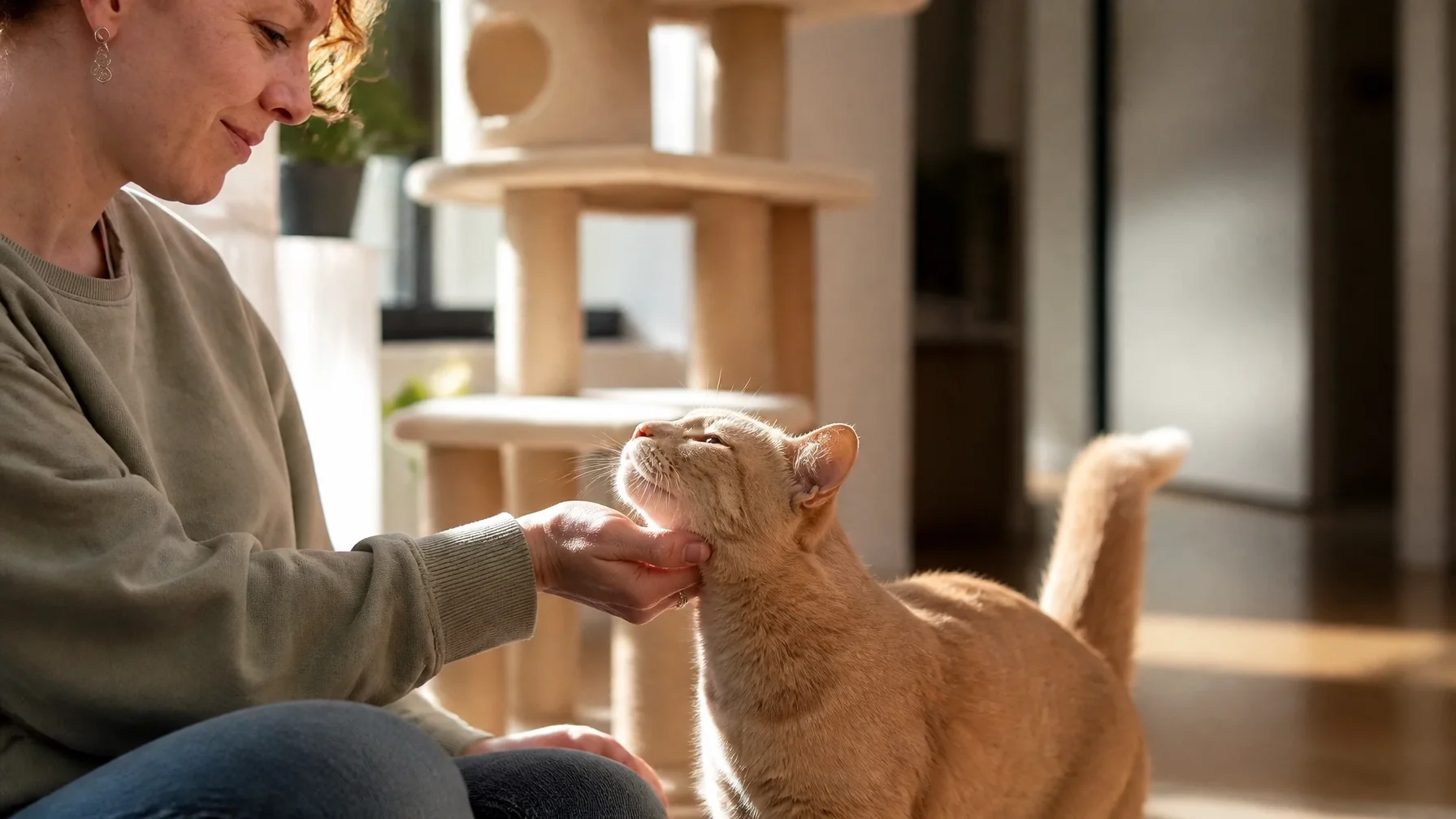
Many cats respond more comfortably to light touch around the cheeks, chin, forehead and areas near the ears. These are sometimes described as the temporal or head regions.
For now, you may wish to reduce or avoid repeated stroking over:
The belly.
The lower back.
The flanks.
The tail base.
Any area that produces flinching, skin rippling or sudden tension.
Please do not assume that every cat will prefer head touch, either. Let your cat’s body language guide you. The goal is not to follow a rigid recipe; it is to discover what your individual cat finds comfortable.
The Case of the One-Stroke Wonder
Let’s meet Mabel, a fictional calico with a very specific policy: one stroke, then review the contract.
Mabel’s person, Priya, thought the cat was being unpredictable. Mabel would climb onto the sofa, head-bump Priya’s hand and purr. Priya would continue stroking along Mabel’s back. After several seconds, Mabel would whip around and bite.
The first investigation revealed three clues:
Mabel initiated contact but became tense after repeated back strokes.
Her tail began twitching several seconds before the bite.
She had no clear way to leave the sofa without passing close to a noisy dog.
Priya began offering short cheek rubs, pausing after each one. She also created a quiet exit route and arranged a veterinary check because Mabel had recently become more touch-sensitive.
The breakthrough was not teaching Mabel to tolerate more petting. It was teaching everyone to notice when she had said, “That is enough.”
Mabel did not need to become a different cat. It was all about decoding the information.
What to do if your cat bites you
If teeth make contact:
Keep your response calm and quiet.
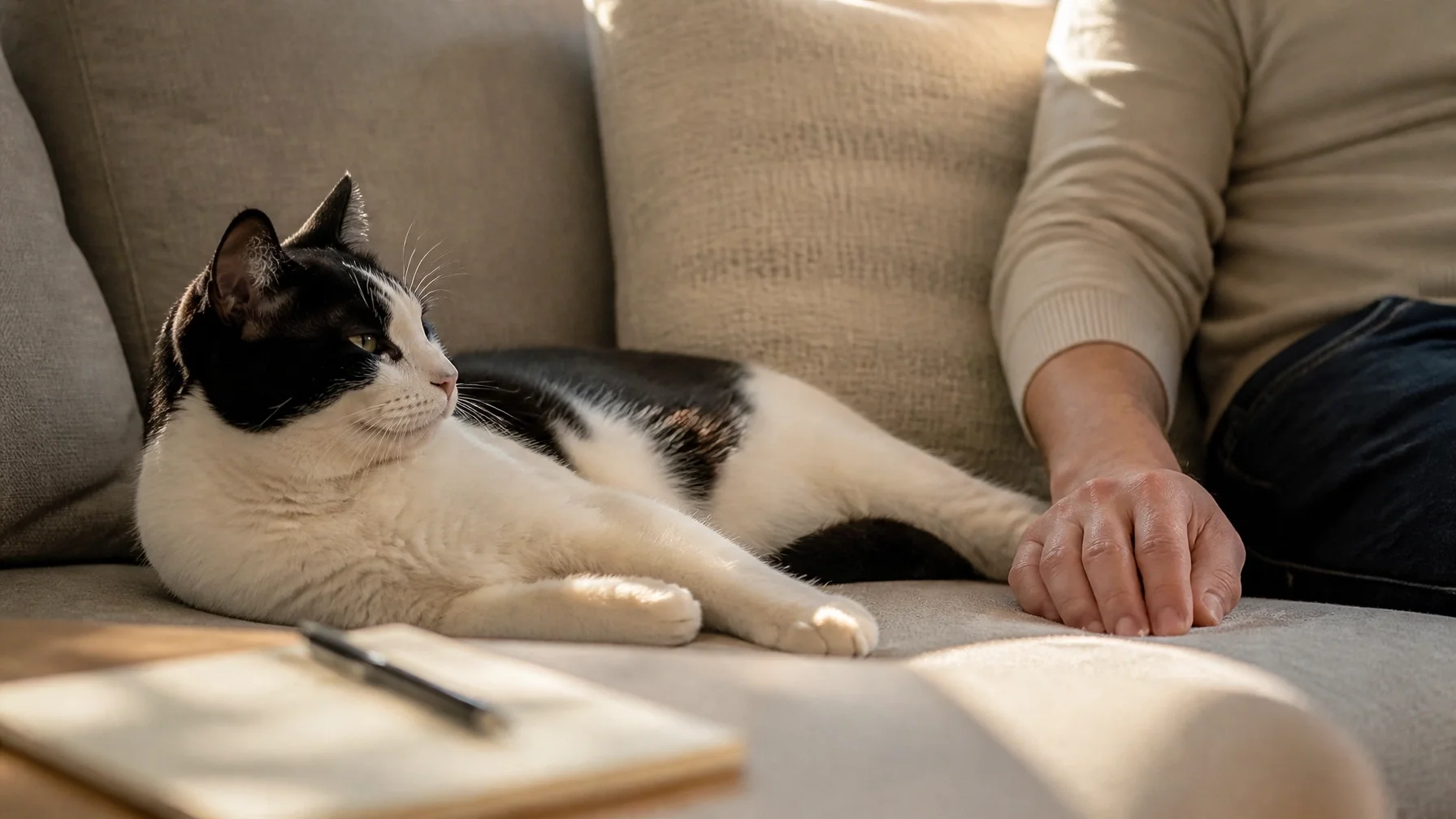
Stop touching your cat.
Give them a clear route away.
Avoid punishment, grabbing or pushing them.
Do not restart petting to “test” whether they are over it.
Wash any wound and seek medical advice if the skin is broken or the injury is significant.
Note what happened immediately before the bite.
A short observation record can help us identify patterns:
Where were you touching?
How long had the interaction lasted?
Did your cat initiate it?
What body-language changes came first?
Could your cat leave?
Was there noise, another animal or a sudden movement?
Has this behaviour changed recently?
Do not wait for a small problem to become a crisis
A behaviour consultation does not replace veterinary care. If aggression is sudden, severe, associated with pain or directed at a particular body area, please start with your vet. At The PAWS Approach, we complement that care by investigating the environment, interaction patterns, body language and reinforcement history. Where appropriate, we can liaise directly with your vet and create a tailored written behaviour modification plan.
You are not failing because your cat bites when you pat them. You have found a communication problem, and communication problems can be improved.
If you feel puzzled, worried or exhausted, our free discovery call is a low-pressure opportunity to describe what is happening, ask questions and decide whether support feels right. There is no commitment to book a consultation.
Your cat may not be giving you a “love bite”. They may be giving you a very clear piece of evidence: “Please listen sooner.”
New posts land here regularly, decoding exactly this kind of thing. Pop your email in to get them straight to your inbox, and as a thank you, we'll send over our free guide, Why Do Cats "Cat"?, so you've got something useful to start with right away.
References
Amat, M., & Manteca, X. (2019). Common feline problem behaviours: Owner-directed aggression. Journal of Feline Medicine and Surgery, 21(3), 245–255. https://doi.org/10.1177/1098612X19831206
Ellis, S. L. H. (2018). Recognising and assessing feline emotions during the consultation: History, body language and behaviour. Journal of Feline Medicine and Surgery, 20(5), 445–456. https://doi.org/10.1177/1098612X18771206
Fritz, J. N., Fletcher, V. L., Dyer, S. P., Carpenter, K. A., Skrbec, M. L., & Yankelevitz, R. L. (2022). Functional analysis and treatment of aggression exhibited by cats toward humans during petting. Journal of Applied Behavior Analysis, 55(1), 169–179. https://doi.org/10.1002/jaba.877
Haywood, C., Ripari, L., Puzzo, J., Foreman-Worsley, R., & Finka, L. R. (2021). Providing humans with practical, best practice handling guidelines during human-cat interactions. Frontiers in Veterinary Science, 8, Article 714143. https://doi.org/10.3389/fvets.2021.714143
Ramos, D., & Mills, D. S. (2009). Human directed aggression in Brazilian domestic cats: Owner reported prevalence, contexts and risk factors. Journal of Feline Medicine and Surgery, 11(10), 835–841. https://doi.org/10.1016/j.jfms.2009.04.006
Rodan, I., Sundahl, E., Carney, H., Gagnon, A.-C., Heath, S., Landsberg, G., & Yin, S. (2011). AAFP and ISFM feline-friendly handling guidelines. Journal of Feline Medicine and Surgery, 13(5), 364–375. https://doi.org/10.1016/j.jfms.2011.03.012