
Is My Cat Bored? Signs of Cat Boredom and Under-Stimulation
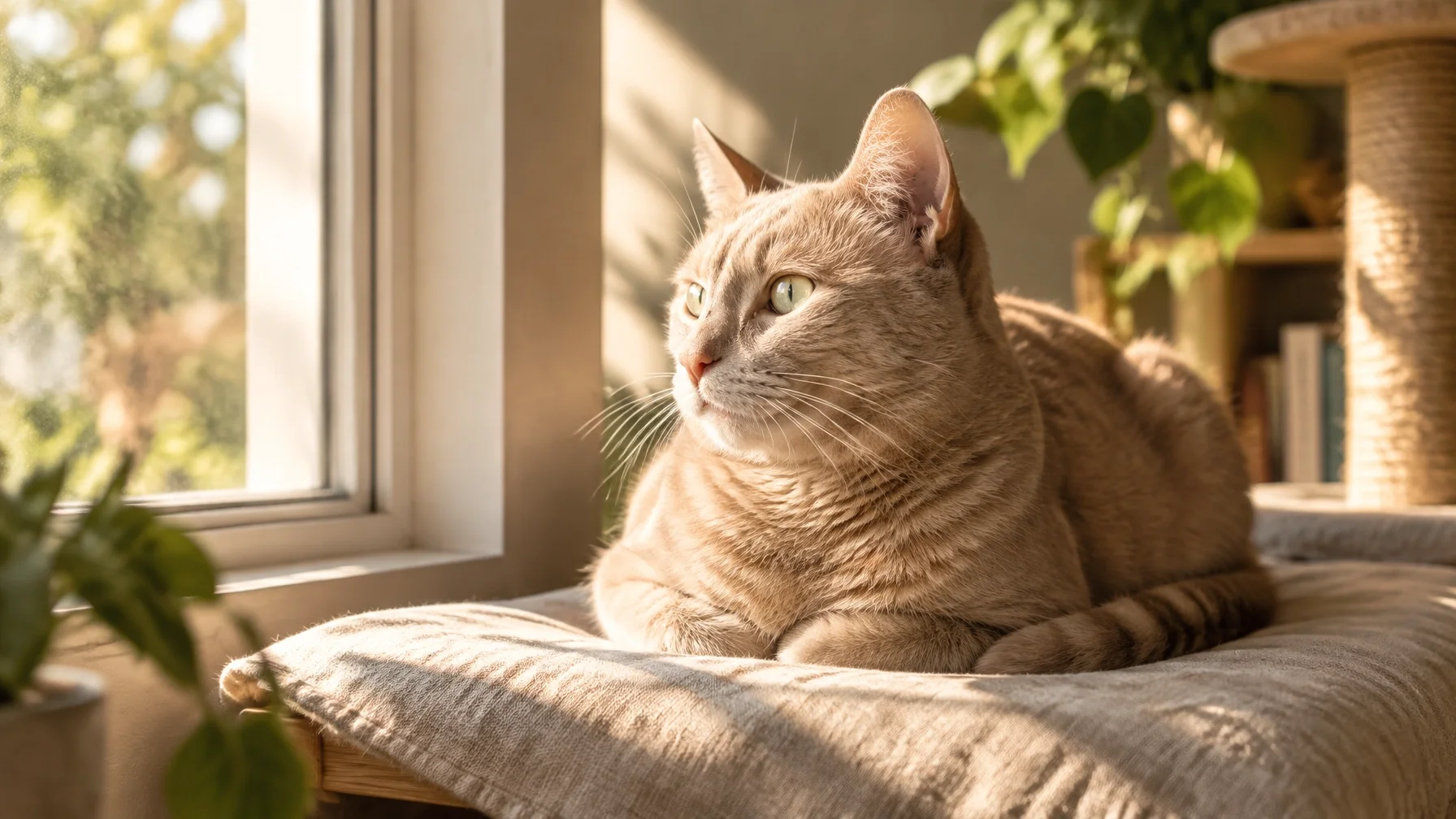
You’re already doing so much right, and the fact that you’re asking, “Is my cat bored?” tells us something important: you’re paying attention.
Perhaps your cat stares at the wall for long stretches. Maybe they knock every object from the bookshelf, wake you at 3 a.m., or lick one patch of fur until it becomes thin. You may be wondering whether they are bored, stressed, unwell, or simply being spectacularly mischievous.
Take a breath. Feline boredom and under-stimulation are common. They are not signs that you have failed your cat. Many loving owners simply do not realise that indoor cats need carefully designed opportunities to climb, explore, hunt, rest, scratch and make choices.
A large Australian owner survey found that many cats’ environmental needs were not being fully met, even though their owners considered themselves knowledgeable about cat care (Lawson et al., 2020). In other words, this is not a guilt problem. It is an information problem, and information gives us somewhere useful to begin.
What boredom looks like in a cat
Boredom is not a formal diagnosis we can confirm from one behaviour. It is better understood as a possible negative emotional state arising when an animal has too little meaningful stimulation or control over their day (Meagher, 2019).
For cats, the clues can be surprisingly subtle.
The “loud” clues
These behaviours may look like naughtiness, but they can be your cat inventing their own entertainment:
Knocking pens, remotes or ornaments from shelves
Scratching furniture, carpets or doorframes
Chasing ankles or ambushing people as they walk past
Calling, yowling or demanding attention repeatedly
Creating 3 a.m. zoomies and household parkour
Chewing unsafe objects or investigating cupboards and drawers
Most indoor cats do not receive enough opportunities for appropriate play. Their predatory play cycle, stalk, chase, pounce, catch, bite, eat, groom and sleep, does not disappear simply because dinner arrives in a bowl. Research links play opportunities with feline welfare, while owner surveys suggest that indoor cats benefit from more varied activities and suitable outlets (Henning et al., 2023; Strickler & Shull, 2014).
Some cats also need to rediscover how to play. A cat who has spent months feeling flat, anxious or physically uncomfortable may not immediately pounce on a toy. We may need to begin with a slow-moving object, a food trail or an interesting cardboard box, and allow them to opt in.
The “quiet” clues
Quiet does not always mean content.
A cat experiencing under-stimulation may:
Sleep more than usual or lie awake without engaging
Watch the room with a flat, distant expression
Eat for something to do, leading to weight gain
Follow you constantly or interrupt every activity
Stop exploring familiar spaces
Groom excessively, particularly the belly, thighs or tail base
Cycle between lethargy and sudden hyper-arousal
Over-grooming, house-soiling and aggression can involve boredom, stress, pain or illness. They are clues, not conclusions. Stress can influence feline behaviour and physiology, and chronic stress may contribute to welfare problems such as lower urinary tract signs in some cats (Stella et al., 2013; Amat et al., 2016).
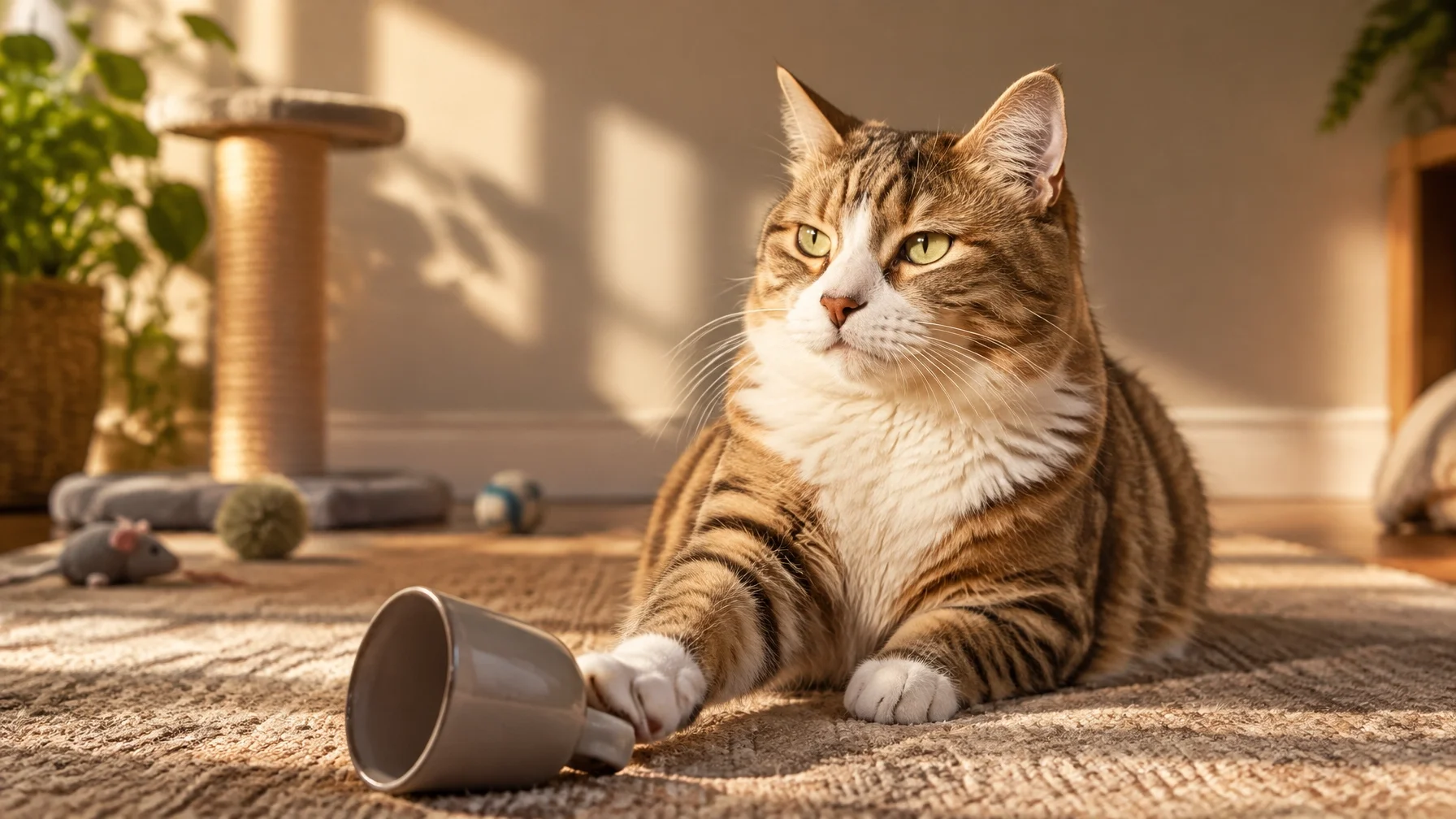
Look for patterns and clusters rather than treating one odd moment as proof of boredom.
The biological detective work: boredom or stress?
Here is where our detective work becomes important. Under-stimulation and over-stimulation can sit surprisingly close together.
A cat with too little appropriate activity may become frustrated and seek intense experiences. A cat with too much unpredictable noise, handling or social pressure may become hypervigilant. Both cats may appear restless, vocal or destructive, but their emotional experiences are different.
This is why we look beyond gadgets and ask:
Can your cat predict what happens next?
Can they move away from people, children or other pets?
Do they have safe elevated and hidden resting places?
Can they choose whether to play, eat, explore or interact?
Are their resources distributed so they do not have to compete?
Does their body language show curiosity and relaxation, or tension and avoidance?
The AAFP and ISFM feline environmental needs guidelines describe a cat-friendly environment as one that supports security, resources, play, scratching, vertical space and respectful human interaction. Enrichment is not about filling a room with plastic toys. It is about improving the cat’s lived experience.
The Australian context: indoor living needs thoughtful design
In Australia, many cats live indoors for their safety, their household’s practical needs and wildlife protection. That can be an excellent choice. Indoor living is not automatically boring or welfare-poor.
But when roaming and hunting are limited, we need to thoughtfully recreate the opportunities that would otherwise occur throughout a cat’s day:
Exploring different levels and routes
Watching safe outdoor activity from a window
Scratching in preferred locations
Searching for food
Chasing and capturing prey-like toys
Retreating to a quiet, secure space
Choosing when social contact begins and ends
The goal is not to turn your home into a feline theme park. It is to make ordinary life more meaningful from your cat’s perspective.
Case file: The Case of the 3 a.m. Wall-Whacker
Consider Noodle, a fictional four-year-old indoor cat whose guardian contacted us after several exhausting months.
Noodle woke the household at 3 a.m., batted picture frames from the hallway wall and launched surprise attacks on passing ankles. During the day, he appeared to sleep constantly. His guardian also noticed a thinning patch on his inner leg from repeated grooming.
The first assumption was that Noodle was naughty at night and lazy during the day. Our investigation suggested a more complicated picture.
Noodle’s days had no reliable rhythm. Food appeared at changing times, interactive play happened only when his guardian had spare energy, and his favourite window perch was often blocked by household items. He had toys, but most had been left permanently on the floor and had become part of the visual wallpaper.
We started with veterinary input to rule out medical contributors to the grooming and activity changes. Then we introduced:
A predictable evening sequence: play, food, grooming opportunity and rest
Short, gentle play sessions rather than one overwhelming workout
Toy rotation, with safe toys stored away between sessions
A clear window-watching station
A choice between a puzzle feeder and a small scatter-feed
Permission to walk away from play without being followed
A quiet overnight activity area that did not involve the bedroom door
Noodle did not transform overnight, and nor should we expect him to. Over time, his guardian reported fewer wall-whacking missions, more relaxed daytime exploration and a softer evening routine.
The solution was not “tire the cat out.” It was to make his day more predictable, interesting and controllable.
The PAWS approach to feline boredom
When we investigate possible under-stimulation, we use the PAWS framework: Predictability, Agency, Welfare and Security.
1. Predictability: start here
Predictability is often the most powerful first adjustment. Cats do not need a timetable accurate to the minute, but they benefit from reliable rhythms.
You might gently introduce:
Meals at broadly consistent times
A familiar cue before play or feeding
A short evening hunting sequence before dinner
Regular quiet periods
Consistent locations for key resources
Our guide to why your cat needs a predictable routine explores this in more detail.
2. Agency: let your cat choose
Enrichment should be an invitation, not an obligation.
Offer options and watch what your cat selects:
A high perch or a covered hide
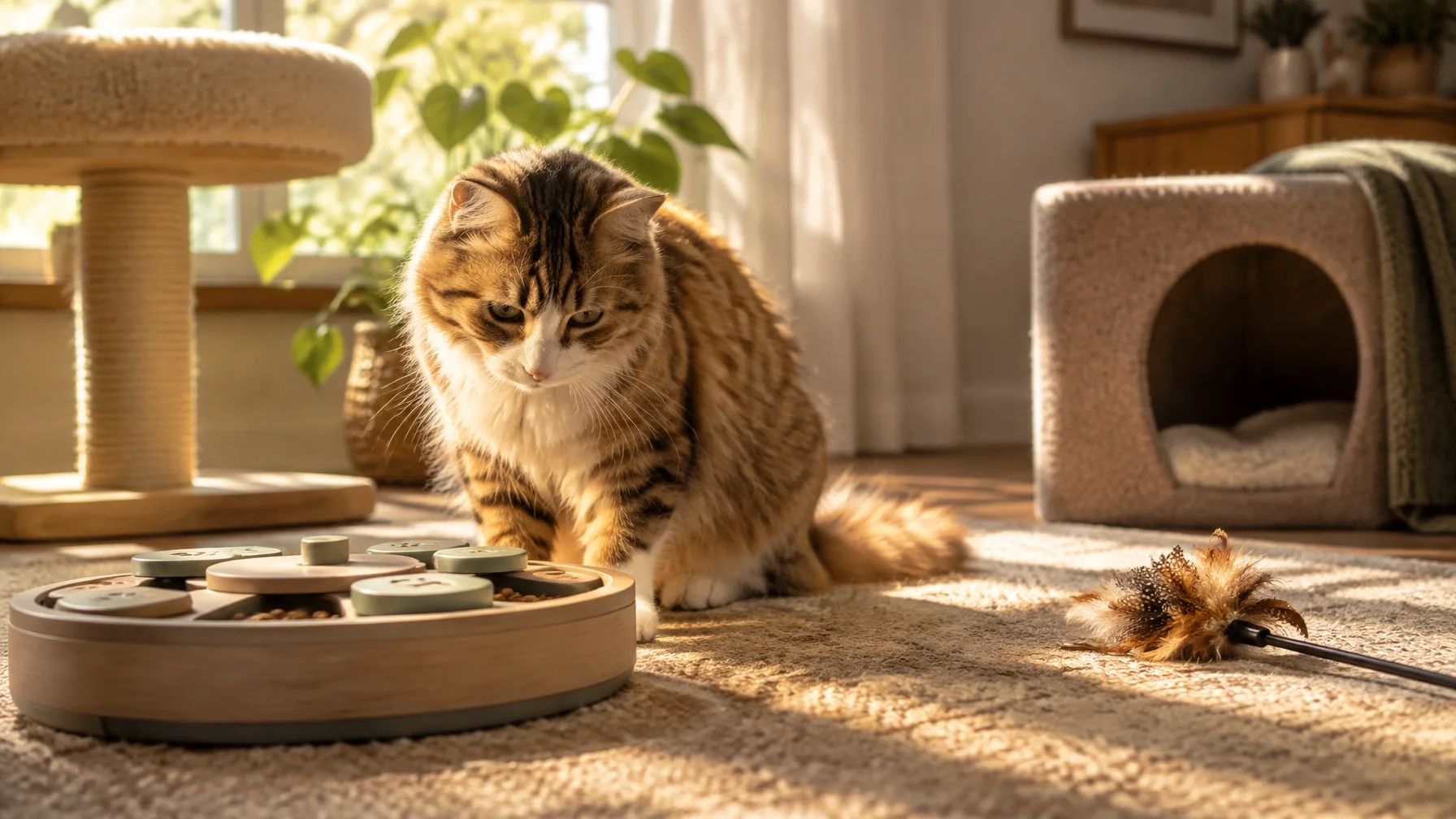
A puzzle feeder or a simple food scatter
A wand toy or a quiet object to investigate
Interaction with you or undisturbed rest
Avoid waving toys in your cat’s face or continuing when their body says “not today”. Consent matters. A cat who walks away is communicating clearly, and respectful responses help preserve trust.
3. Welfare: look inside the behaviour
Welfare is not just the presence of toys. It includes physical comfort, emotional wellbeing, sleep, appetite, movement and the ability to experience positive states such as curiosity and satisfaction.
If your cat is over-grooming, losing weight, gaining weight, urinating outside the litter tray or showing a sudden change in activity, please arrange a veterinary assessment. Environmental modification can complement veterinary treatment; it does not replace it. Vet-led multimodal environmental modification has been studied in cats with idiopathic cystitis, where reducing stressors and improving environmental control may form part of management (Buffington et al., 2006a; Buffington et al., 2006b).
4. Security: make retreat possible
A bored cat may need more stimulation. A stressed cat may need less pressure. Both need safe places to retreat.
Consider:
Elevated resting areas
Covered beds or boxes
Scratching surfaces near sleeping areas
Multiple, separated resources in multi-cat homes
Clear escape routes
A calm space away from household traffic
Cats do not always “sort it out” themselves. When their environment repeatedly puts them in difficult situations, problem behaviours can develop or become more established (Bradshaw, 2018).
Do not wait for the crisis point
If your cat’s behaviour has changed suddenly, please start with your vet. Pain, skin disease, urinary problems and other medical conditions can look like boredom or stress. Once medical contributors have been considered, a cat behaviourist can help you investigate the environment, body language and daily patterns.
If you are in Canberra, we offer in-person consultations, and we provide online support for families further afield. Our process begins with a free, low-pressure discovery call: an opportunity to describe what is happening, with no commitment. We can then complete a detailed assessment and create a written, cat-centred behaviour plan in collaboration with your vet where appropriate.
Book a free discovery call with The PAWS Approach and let’s work out what your cat may be trying to tell you.
New posts land here regularly, decoding exactly this kind of thing. Pop your email in to get them straight to your inbox, and as a thank you, we'll send over our free guide, Why Do Cats "Cat"?, so you've got something useful to start with right away.
References
Amat, M., Camps, T., & Manteca, X. (2016). Stress in owned cats: Behavioural changes and welfare implications. Journal of Feline Medicine and Surgery, 18(8), 577–586. https://doi.org/10.1177/1098612X15590867
Bradshaw, J. (2018). Normal feline behaviour: … and why problem behaviours develop. Journal of Feline Medicine and Surgery, 20(5), 411–421. https://doi.org/10.1177/1098612X18771203
Buffington, C. A. T., Westropp, J. L., Chew, D. J., & Bolus, R. (2006a). Risk factors associated with clinical signs of lower urinary tract disease in indoor-housed cats. Journal of the American Veterinary Medical Association, 228(5), 722–725. https://doi.org/10.2460/javma.228.5.722
Buffington, C. A. T., Westropp, J. L., Chew, D. J., & Bolus, R. R. (2006b). Clinical evaluation of multimodal environmental modification (MEMO) in the management of cats with idiopathic cystitis. Journal of Feline Medicine and Surgery, 8(4), 261–268. https://doi.org/10.1016/j.jfms.2006.02.002
Ellis, S. L. H., Rodan, I., Carney, H. C., Heath, S., Rochlitz, I., Shearburn, L. D., Sundahl, E., & Westropp, J. L. (2013). AAFP and ISFM feline environmental needs guidelines. Journal of Feline Medicine and Surgery, 15(3), 219–230. https://doi.org/10.1177/1098612X13477537
Henning, J., Nielsen, T., Fernández, E. J., & Hazel, S. (2023). Cats just want to have fun: Associations between play and welfare in domestic cats. Animal Welfare, 32, e9. https://doi.org/10.1017/awf.2023.2
Lawson, G. T., Langford, F. M., & Harvey, A. M. (2020). The environmental needs of many Australian pet cats are not being met. Journal of Feline Medicine and Surgery, 22(10), 898–906. https://doi.org/10.1177/1098612X19890189
Meagher, R. K. (2019). Is boredom an animal welfare concern? Animal Welfare, 28(1), 21–32. https://doi.org/10.7120/09627286.28.1.021
Stella, J., Croney, C., & Buffington, T. (2013). Effects of stressors on the behavior and physiology of domestic cats. Applied Animal Behaviour Science, 143(2–4), 157–163. https://doi.org/10.1016/j.applanim.2012.10.014
Strickler, B. L., & Shull, E. A. (2014). An owner survey of toys, activities, and behavior problems in indoor cats. Journal of Veterinary Behavior, 9(5), 207–214. https://doi.org/10.1016/j.jveb.2014.06.005