
Why Doesn't My Cat Play Anymore? What a Lost Interest in Toys Is Trying to Tell You
You dangle your cat’s favourite wand toy. Nothing. You rustle the crinkle ball. Still nothing. The toy that once inspired Olympic-level zoomies now receives the kind of reaction usually reserved for an unwanted email.
You’re already doing something right: you’ve noticed the change.
A cat who used to play and now ignores toys is giving us useful information. It does not automatically mean you have failed, your cat is “lazy”, or your bond is slipping away. This is common, often fixable, and worth investigating with a calm, cat-centred approach.
Most cats, particularly indoor cats, need regular opportunities to express natural hunting behaviours. Their play is not just entertainment; it can support movement, problem-solving, choice and emotional wellbeing. Research has found associations between play and welfare in domestic cats, while also showing that daily play can be difficult for owners to provide consistently (Henning et al., 2023; Delgado et al., 2024).
So, what is the mystery behind the abandoned toy?
First, understand the full predatory play cycle
For cats, play is most satisfying when it resembles a miniature hunt:
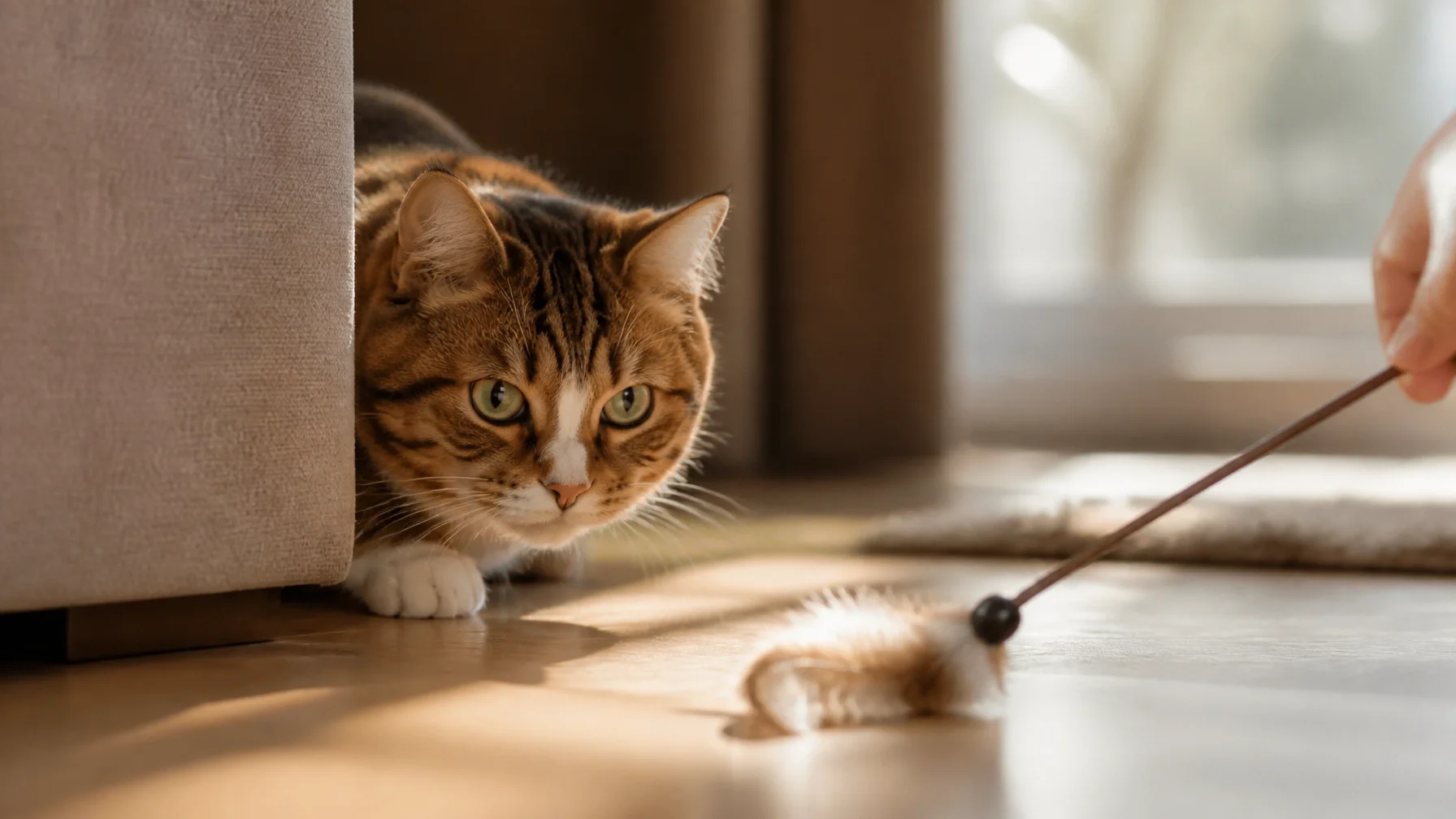
Stalk – watching, orienting and creeping towards “prey”.
Chase – following movement as the toy escapes.
Catch – pouncing, grabbing and holding.
Eat – chewing or receiving a small food reward.
Rest and groom – settling after the sequence is complete.
This sequence matters. Waving a toy directly in a cat’s face, moving it constantly or removing it every time they catch it can make the game confusing or unrewarding.
Play behaviour is flexible and changes throughout a cat’s life. It can also be rediscovered. A cat who has lost interest may need us to gently teach them that play is available, safe and worth joining again, not pressure them into performing.
The PAWS investigation: start with the “W” , Welfare
At The PAWS Approach, the W in PAWS begins inside the cat.
Before we assume boredom, we investigate pain, stress and physical-emotional wellbeing. Play is a secondary support while we first make sure your cat feels well enough to participate.
Pain can look like disinterest
Cats are exceptionally skilled at hiding discomfort. A reduction in play may be one of the quiet clues that movement, jumping, biting or sudden bursts of activity no longer feel good.
Possible contributors include:
Arthritis or other joint pain, particularly in older cats.
Dental or oral disease, where biting and carrying toys may hurt.
Injury, illness or reduced energy.
Weight-related mobility challenges.
Stress-related health concerns, including urinary signs that may require your vet to investigate conditions such as feline idiopathic cystitis.
The AAFP Feline Senior Care Guidelines note the importance of looking for subtle changes in mobility, behaviour and comfort as cats age (Ray et al., 2021). Oral disease can also affect how cats behave; a clinical trial found changes in pain-related behaviours after treatment of dental disease (Watanabe et al., 2020).
Please treat the following as reasons to contact your vet, especially if they are new or worsening:
Sleeping more or withdrawing.
Avoiding stairs, jumping or climbing.
Eating differently, dropping food or chewing cautiously.
Grooming less, overgrooming or becoming touch-sensitive.
Hiding more often.
Changes in drinking, urination, toileting or appetite.
Limping, stiffness, vocalisation or unusual irritability.
A veterinary work-up comes first. Location, substrate and behavioural clues are starting points for investigation, not definitive diagnoses. The PAWS Approach complements veterinary care, we do not replace it.
Stress can switch off play
A cat who feels unsafe may spend their available energy scanning, hiding or avoiding conflict rather than chasing a toy. Changes that seem small to us can be significant from the cat’s perspective:
A new pet, baby, visitor or housemate.
Tension with another cat.
Renovations, furniture changes or moving house.
Noisy appliances, neighbours or unpredictable household activity.
A disrupted feeding, sleep or work routine.
A play area that leaves the cat exposed or easily ambushed.
Cats need control over their essential resources and resting spaces. The AAFP and ISFM Feline Environmental Needs Guidelines describe the importance of safe places, separated resources, opportunities for play and predictable interaction (Ellis et al., 2013).
This is why “cats will sort it out” is not a welfare plan. Cats may avoid, freeze or quietly restrict their lives instead. A cat who stops playing may be telling us, “I don’t feel sufficiently safe or comfortable here.”
The Case of the Uninterested Tabby
Imagine Milo, a fictional seven-year-old tabby who once chased a feather wand every evening. His person, Sam, assumed he had become bored.
During a vet check, Milo was found to have painful dental disease. At home, Sam also noticed that the other cat regularly blocked the hallway where play usually happened. Milo’s lost play was not one simple puzzle. It was a combination of mouth pain and reduced confidence in a busy part of the home.
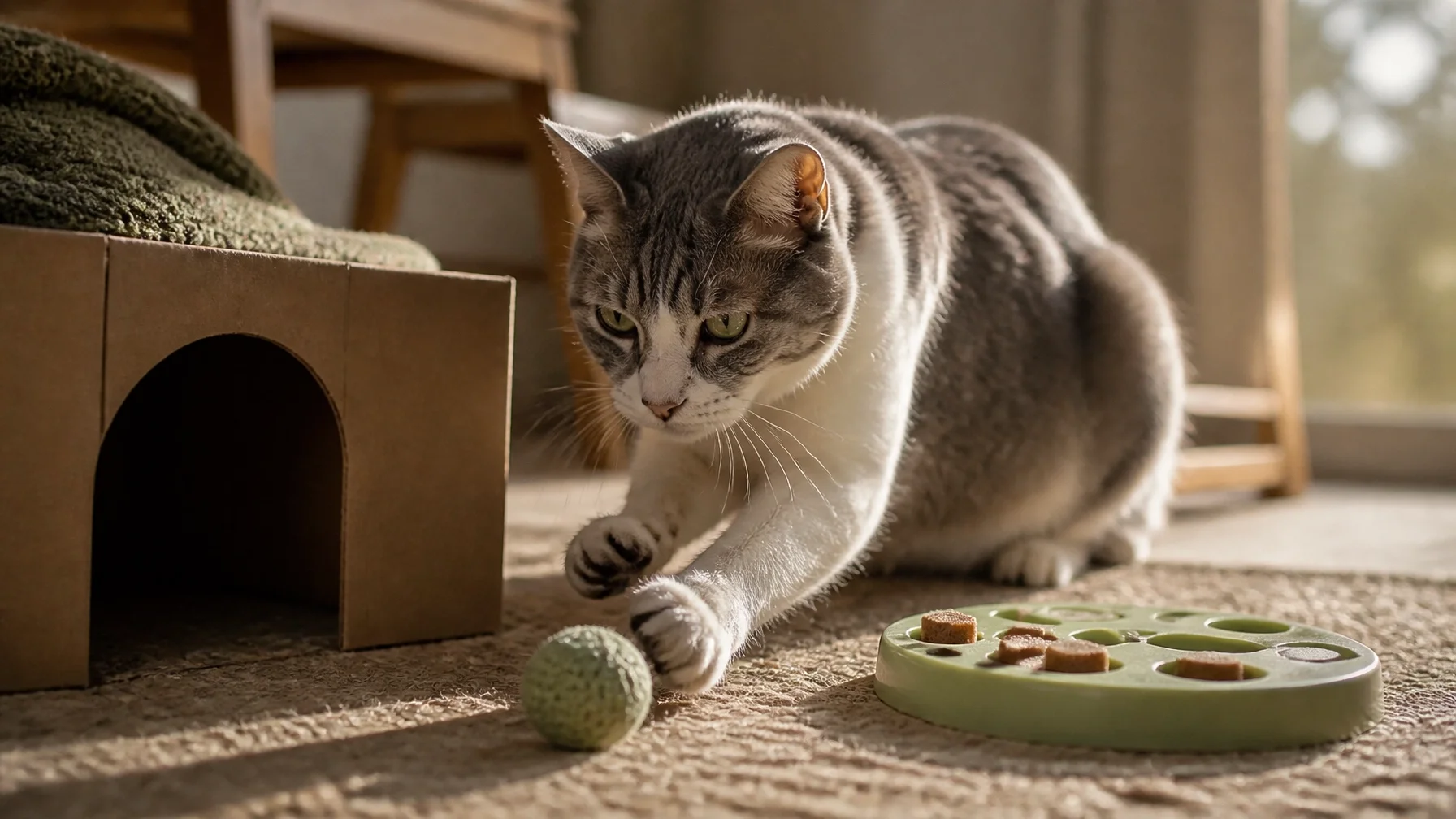
After veterinary treatment, environmental changes and quieter play sessions in a protected area, Milo began by watching the toy. Then he reached one paw. A few days later, he stalked it around the edge of a cardboard box.
That was progress, not a performance review.
How to help a cat rediscover play
Once medical concerns are being addressed, we can make play easier, safer and more rewarding.
1. Follow your cat’s consent
Invite rather than insist.
Offer the toy at a comfortable distance.
Pause when your cat looks away, retreats or becomes tense.
Let your cat approach, disengage and return.
Avoid grabbing, cornering or physically placing your cat into a play session.
A good session may involve watching, one paw tap or a short chase. Choice is part of the enrichment.
2. Rebuild the hunt slowly
Begin with the stalk, not a frantic chase.
Move the toy away from your cat along the floor.
Let it disappear behind furniture or a box.
Use pauses so your cat can observe and plan.
Keep movements irregular but not chaotic.
Allow frequent catches.
Finish with a small food reward, meal or lickable treat if appropriate.
For older or stiff cats, keep the toy low and avoid demanding leaps. A gentle ground-level pounce still counts.
Cats with outdoor access are not necessarily finished with predatory play, either. Research suggests indoor-only cats may show strong interest in predatory play, indicating that experience does not remove the need for suitable opportunities (Pyari et al., 2021).
3. Change the conditions, not just the toy
Try:
Short sessions of two to five minutes.
Play during your cat’s naturally active periods.
A quieter room away from other pets.
Different toy textures and movement styles.
Toy rotation rather than leaving every toy out all the time.
Food puzzles, scatter feeding, climbing options and safe observation points.
The review of cat play by Delgado and Hecht explains that play is shaped by development, environment and motivation, not simply by whether a cat owns enough toys (Delgado & Hecht, 2019).
What to do this week
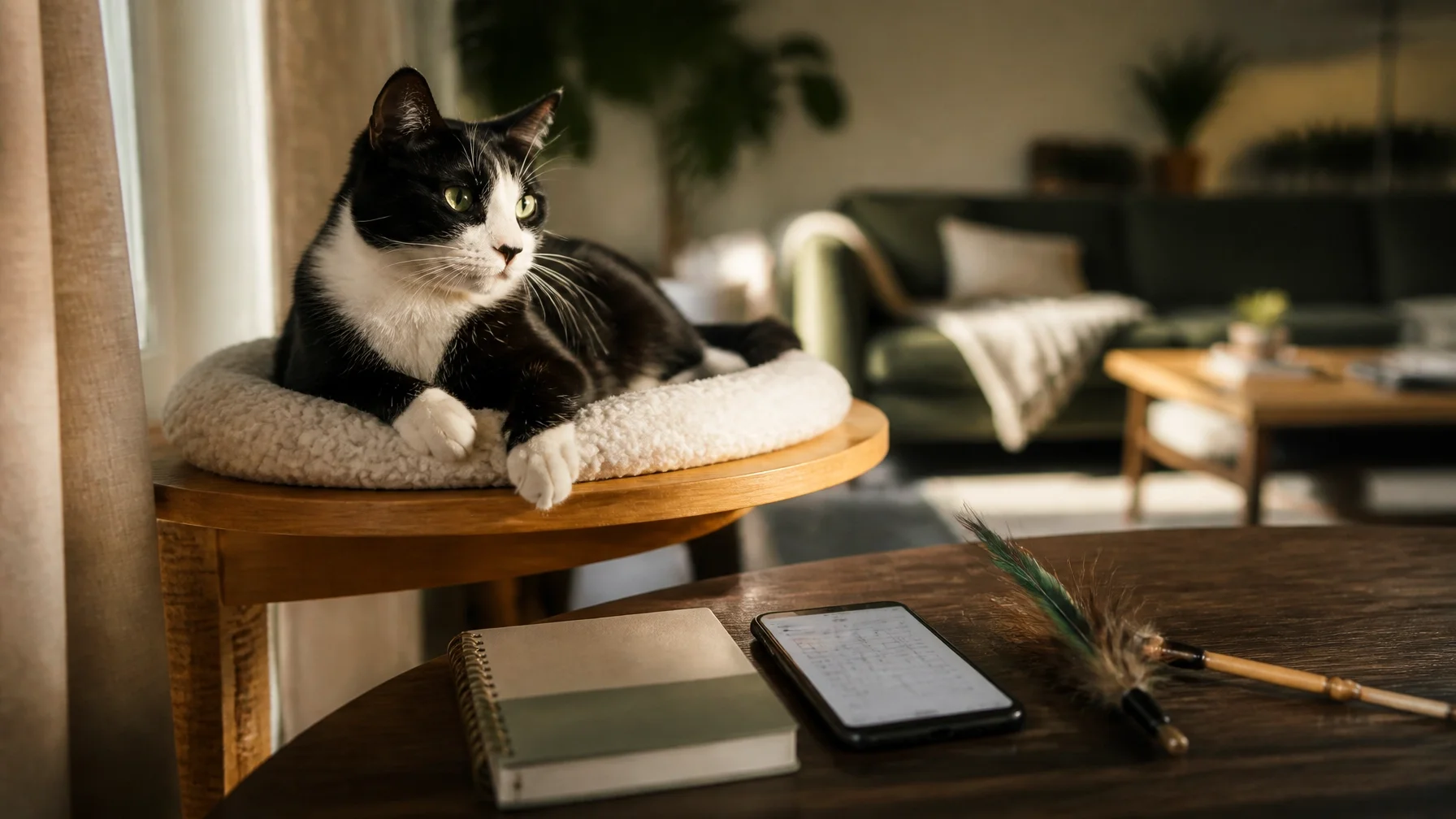
Keep a simple observation note for seven days:
When does your cat choose to be active?
Which toys receive even a glance?
Does your cat engage more when the house is quiet?
Are there changes in appetite, grooming, mobility or toileting?
Does another pet appear before your cat withdraws?
What happens immediately before and after attempted play?
Please book a veterinary appointment promptly for sudden loss of play, signs of pain or any other physical or behavioural change. If your vet rules out medical causes: or if stress and environmental patterns remain: behaviour support can help you identify the next kind step.
You do not need to wait until a small concern becomes a crisis. The escalation path can look like this:
Lost play → hidden pain or stress → worsening welfare → crisis, including emergency vet bills or rehoming pressure.
Early support is not overreacting. It is what attentive, caring ownership looks like.
When The PAWS Approach can help
If you feel puzzled, worried or exhausted, we can help you investigate the pattern from your cat’s perspective. Our one-on-one consultations are complementary to veterinary care and may include:
A detailed look at your cat’s environment and body language.
Exploration of pain, stress and welfare factors alongside veterinary information.
Practical, reinforcement-based play and enrichment strategies.
A tailored written behaviour modification plan.
Liaison with your vet where appropriate.
A free discovery call is a low-pressure opportunity to describe what is happening, ask questions and decide whether support feels right: with no commitment. If you are ready to take the next step, you can book a consultation.
Your cat has not failed at play, and neither have you. Together, we can listen more closely to what the abandoned toy is trying to tell us.
References
Delgado, M., & Hecht, J. (2019). A review of the development and functions of cat play, with future research considerations. Applied Animal Behaviour Science, 214, 1–17. https://doi.org/10.1016/j.applanim.2019.03.004
Henning, J., Nielsen, T., Fernández, E. J., & Hazel, S. (2023). Cats just want to have fun: Associations between play and welfare in domestic cats. Animal Welfare, 32, e9. https://doi.org/10.1017/awf.2023.2
Pyari, M. S., Uccheddu, S., Lenkei, R., & Pongrácz, P. (2021). Inexperienced but still interested – Indoor-only cats are more inclined for predatory play than cats with outdoor access. Applied Animal Behaviour Science, 241, 105373. https://doi.org/10.1016/j.applanim.2021.105373
Delgado, M., Marcinkiewicz, E., Rhodes, P., & Ellis, S. L. H. (2024). Identifying barriers to providing daily playtime for cats: A survey-based approach using COM-B analysis. Applied Animal Behaviour Science, 280, 106420. https://doi.org/10.1016/j.applanim.2024.106420
Ray, M., Carney, H. C., Boynton, B., Quimby, J., Robertson, S., St. Denis, K., Tuzio, H., & Wright, B. (2021). 2021 AAFP Feline Senior Care Guidelines. Journal of Feline Medicine and Surgery, 23(7), 613–638. https://doi.org/10.1177/1098612X211021538
Watanabe, R., Frank, D., & Steagall, P. V. (2020). Pain behaviors before and after treatment of oral disease in cats using video assessment: A prospective, blinded, randomized clinical trial. BMC Veterinary Research, 16, 100. https://doi.org/10.1186/s12917-020-02302-w
Ellis, S. L. H., Rodan, I., Carney, H. C., Heath, S., Rochlitz, I., Shearburn, L. D., Sundahl, E., & Westropp, J. L. (2013). AAFP and ISFM feline environmental needs guidelines. Journal of Feline Medicine and Surgery, 15(3), 219–230. https://doi.org/10.1177/1098612X13477537