
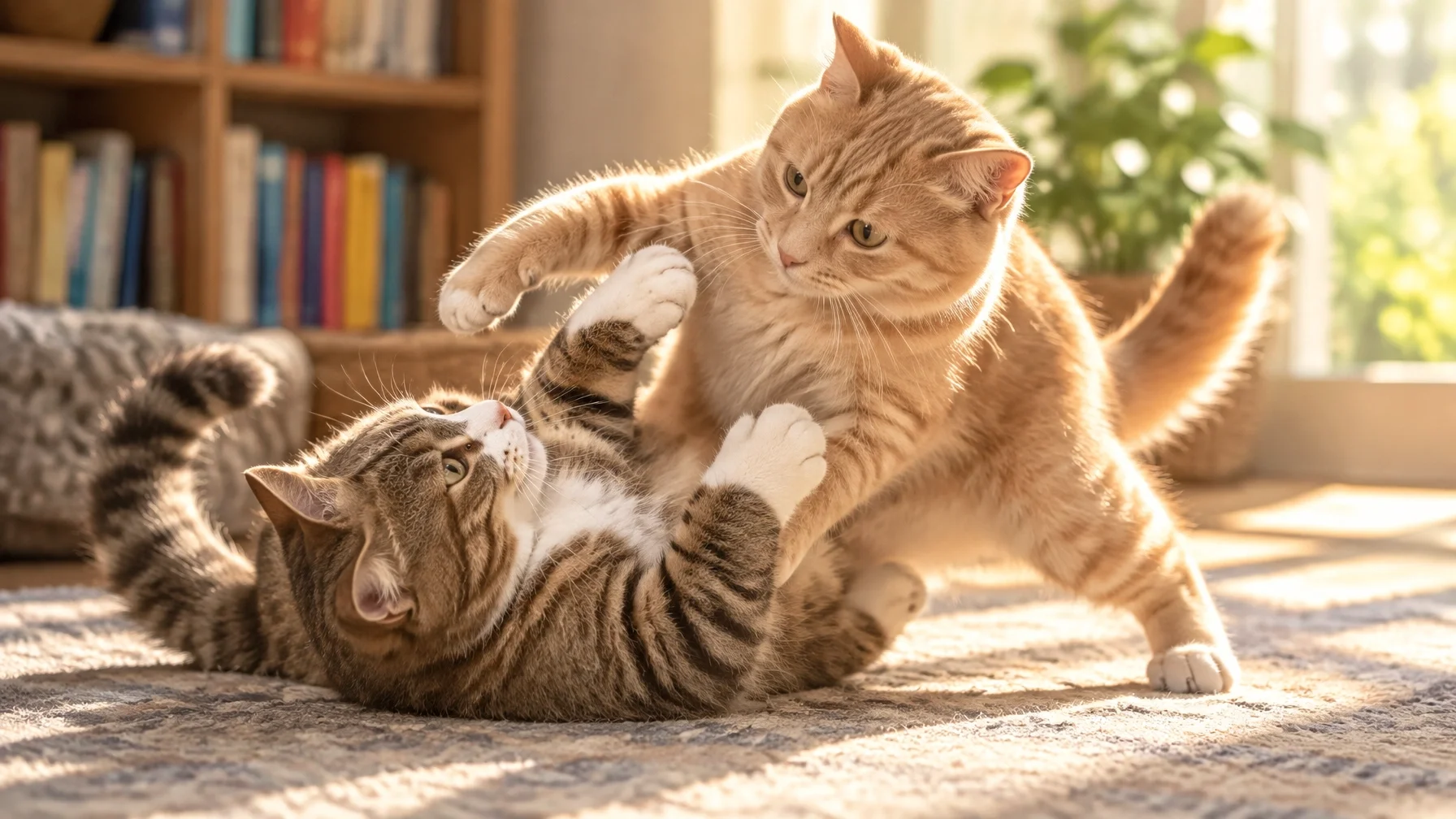
You know the scene. Two cats tumble across the hallway like furry gymnasts. One lets out a dramatic yowl. There is a brief pause. Then both cats wander off and behave as though nothing happened.
So… was that play or fighting?
You are already doing something important by noticing and asking. This is genuinely difficult to read, even for experienced cat owners, because play and conflict share a surprising amount of physical vocabulary. It is not your fault. It is a reading problem, and reading cat body language is a learnable skill.
Getting it wrong in either direction matters:
Dismissing real tension as “they’re just playing” can allow it to grow.
Interrupting genuine play can remove an important welfare need.
Assuming cats will “sort it out” can leave one cat quietly living around another’s threats.
Let’s investigate from the cats’ perspective.
Why play and conflict can look so similar
Cats are socially flexible rather than obligately group-living animals. Some enjoy close feline friendships. Some prefer peaceful distance. Others can tolerate a housemate when the environment gives them enough space, choice and security.
That means a multi-cat household is not automatically a feline friendship club. Related cats and cats who grew up together may be more likely to develop affiliative relationships, including close resting and mutual grooming, than unrelated adults brought together later. Familiarity and relatedness have been associated with proximity and allogrooming in domestic cats (Curtis et al., 2003).
But genetics and history are not destiny. The home environment still matters enormously.
The AAFP and ISFM feline environmental needs guidelines describe cats’ need for safe places, separated resources, opportunities for normal behaviour and predictable, respectful interaction (Ellis et al., 2013). In other words, intercat tension is often less about a “dominant” cat or a “difficult” personality and more about resource security.
The detective’s guide: cat fighting or playing?
When we investigate is this cat play or fighting, we look at the whole pattern rather than one dramatic paw swipe.
Signs it is more likely play
Bodies are loose, curved and bouncy.
Both cats take turns chasing, pinning or being chased.
Ears are mostly upright or relaxed.
Fur lies flat.
Claws appear controlled rather than raking.
Bites are inhibited and do not cause injury.
There are natural pauses where the cats look away, groom, reset or wander off.
Both cats voluntarily re-engage.
A brief squeak or protest hiss does not automatically turn play into conflict. It may simply mean, “That move was too enthusiastic, thank you.” Watch what happens next: does the other cat pause and adjust, or continue pursuing?
Signs it is more likely tension or fighting
One cat always chases and the other always flees.
One cat repeatedly hides, freezes or tries to escape.
Bodies become stiff, low, sideways or intensely forward.
Ears flatten or rotate sharply sideways.
Tails lash, tuck or puff.
Fur stands up along the back or tail.
There is sustained hissing, growling, yowling or screaming.
One cat blocks the other’s route, doorway, food, resting area or litter tray.
Hard staring continues during pauses.
Claws are extended, bites are forceful or there is injury.
The aftermath is evidence too. Following healthy play, both cats generally return to ordinary life. Following conflict, one cat may avoid rooms, resources or the other cat.
Do my cats actually like each other?
“Like” is a very human word, but it can be useful if we translate it into observable feline behaviour.
Signs of a genuine affiliative relationship may include:
Resting close together by choice.
Touching or sleeping in contact.
Allogrooming, especially when both cats participate.
Friendly nose touches.
Tail-up greetings.
Relaxed approaches and soft facial expressions.
Slow blinking in calm proximity.
One cat choosing to follow or settle near the other without pressure.
No single behaviour proves friendship. A pair can sleep on the same sofa because it is the warmest sofa in the house. We are looking for a repeated pattern of voluntary, relaxed proximity.
On the other hand, signs of a strained relationship may be quiet:
One cat always leaves when the other arrives.
There are staring contests across hallways.
A cat blocks doorways or narrow passages.
Resources are guarded.
One cat stays on the floor while the other uses high resting places.
A cat only visits food or litter areas when the other is asleep.
There is hiding, over-grooming, spraying or litter tray avoidance.
A household can contain one bonded pair, one neutral relationship and one tense relationship all at the same time. “They get along” is not always a whole-household diagnosis.
Resource security: the missing clue in many multi-cat households
Cats need the ability to access essentials without being ambushed, watched or forced into a narrow passage beside another cat.
Think about:
Food and water stations.
Litter trays.
Scratching areas.
Resting places.
Hiding spots.
Elevated perches.
Routes through the home.
Resources should be duplicated and distributed, not lined up together like a feline cafeteria. Ideally, each cat can approach, use and leave a resource without being trapped or observed by a housemate.
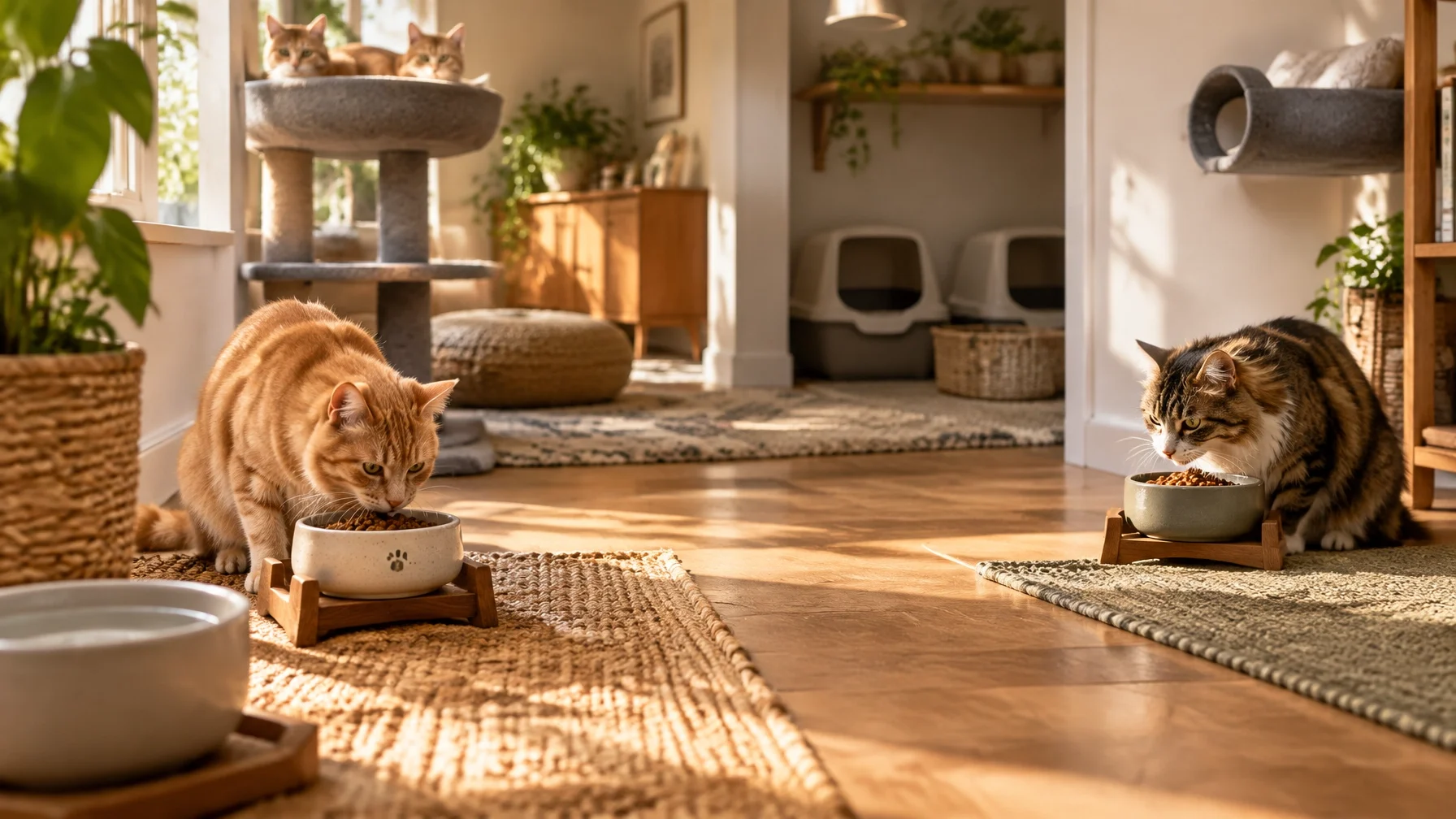
An example of all the resources lined up creating potential access bottle necks
This is where our PAWS framework helps:
Predictability: Keep feeding, play and household routines reasonably consistent.
Agency: Give every cat the option to leave, avoid or rest undisturbed.
Welfare: Provide opportunities for scratching, hiding, climbing, exploring and predatory play.
Security: Make food, water, litter trays and resting places reliably accessible.
Many indoor cats do not receive enough interactive predatory play. A cat with unused chase-and-catch energy may redirect some of that energy towards a housemate. Play is not a cure for intercat tension, but regular, consent-based play with each cat separately can support welfare and reduce the pressure on the relationship. Our guide to why your cat may have stopped playing can help if one cat has become difficult to engage.
The “out of nowhere” case: redirected aggression
Redirected aggression is one of the most misunderstood multi-cat household crises.
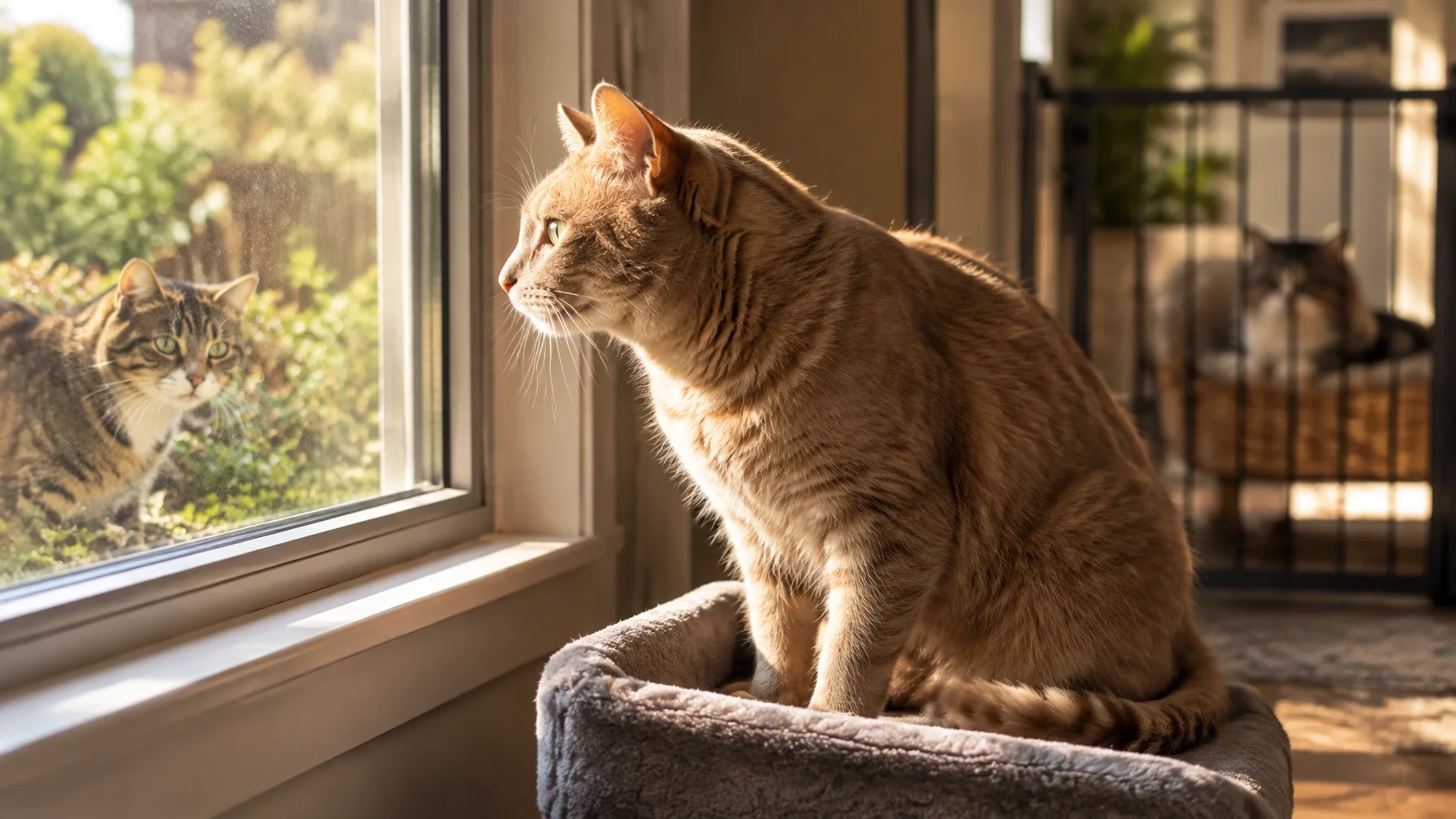
A cat sees an unfamiliar outdoor cat through the window. Their arousal rises, but they cannot reach the intruder. A housemate walks past at exactly the wrong moment. The indoor cat attacks the nearby target instead.
The housemate may appear to be the cause, but they are often simply the available target.
If this happens:
Do not put your hands between fighting cats.
Use a solid barrier, closed door or other non-contact method to separate them.
Reduce the original trigger, such as blocking the window view or preventing an unfamiliar cat from entering through a cat flap.
Give both cats separate resources and quiet recovery space.
Do not rush them back together because they were previously “best friends”.
Reintroduce gradually once both cats are calm, ideally with veterinary and behaviour support.
Arousal can remain high long after the outdoor cat has disappeared. Separation is not punishment here. It is a welfare measure that gives nervous systems time to settle.
The Case of the Midnight Hallway Summit
Marmalade and Juniper were described by their family as “best friends”. They had arrived months apart but had always played chase and slept on the same bed.
Then the family noticed Juniper avoiding one litter tray. Marmalade had also started sitting in the hallway, watching Juniper whenever she approached the laundry. There were no dramatic fights, only a repeated pattern:
Marmalade blocked the route.
Juniper waited, retreated or chose another location.
Their wrestling became increasingly one-sided.
Juniper stopped using part of the home.
The investigation found a security problem, not a personality problem. Their food bowls, water and litter trays were concentrated in a few high-traffic areas. The hallway was also the only route to a favourite resting room.
The family introduced:
Duplicated litter trays in separate, quiet locations.
Separate feeding areas with clear exits.
Visual breaks around the hallway.
Predictable feeding times.
Individual interactive play.
Calm opportunities for each cat to opt out.
They did not punish Marmalade or force Juniper to “stand up for herself”. Over time, the hallway stopped being a negotiation point. The cats did not need to become inseparable again. Peaceful coexistence, with genuine choice, was the goal.
When a vet check comes first
A sudden change in an established relationship is a medical question before it is a training question.
Pain, dental disease, arthritis, hyperthyroidism, sensory decline and other health changes can alter a cat’s tolerance, movement and response to housemates. Please arrange a veterinary work-up promptly if a previously peaceful pair suddenly becomes tense, or if aggression appears alongside changes in appetite, mobility, grooming, toileting or sleep.
Stress can also affect physical health and behaviour. Feline research has linked environmental stressors with changes in activity, grooming, social interaction and sickness behaviours (Stella et al., 2013; Amat et al., 2016). If you are also seeing litter tray avoidance or house-soiling, our guide to what that puddle may be trying to tell you may help you prepare for the vet conversation.
What to do next
Please consider observing and recording:
Who approaches whom?
Who initiates and who escapes?
Do roles change?
Are there pauses and relaxed resets?
What happens immediately beforehand?
What happens afterwards?
Is a resource, doorway or window involved?
Small tension ignored can become resource guarding, blocked litter tray access, spraying, house-soiling, over-grooming or withdrawal. The escalation path is often:
subtle tension → repeated avoidance → resource restriction → stress behaviours → crisis.
That crisis may mean significant veterinary costs, one cat living under the bed or pressure to rehome. We do not share this to frighten you. We share it because early support is kinder and usually gives us more options.
These body-language clues are starting points for investigation, not diagnoses. Sudden aggression or behaviour change warrants veterinary assessment first. A full behaviour assessment is needed to understand each cat, the home layout, the relationship pattern and the safest individual plan. Please avoid punishment, forced proximity and physical intervention during fights.
If you are in Canberra or Queanbeyan, or further afield and would like online support, we can help. Book a low-pressure, free 15-minute Discovery Call at thepawsapproach.au/book. There is no commitment, you can simply describe what is happening and ask whether support is appropriate. You can also call (+61) 02 4062 0105.
References
Amat, M., Camps, T., & Manteca, X. (2016). Stress in owned cats: Behavioural changes and welfare implications. Journal of Feline Medicine and Surgery, 18(8), 577–586.
Barry, K. J., & Crowell-Davis, S. L. (1999). Gender differences in the social behavior of the neutered indoor-only domestic cat. Applied Animal Behaviour Science, 64(3), 193–211.
Bradshaw, J. (2018). Normal feline behaviour: … and why problem behaviours develop. Journal of Feline Medicine and Surgery, 20(5), 411–421.
Curtis, T. M., Knowles, R. J., & Crowell-Davis, S. L. (2003). Influence of familiarity and relatedness on proximity and allogrooming in domestic cats (Felis catus). American Journal of Veterinary Research, 64(9), 1151–1154.
Ellis, S. L. H. (2009). Environmental enrichment: Practical strategies for improving feline welfare. Journal of Feline Medicine and Surgery, 11(11), 901–912.
Ellis, S. L. H., Rodan, I., Carney, H. C., Heath, S., Rochlitz, I., Shearburn, L. D., Sundahl, E., & Westropp, J. L. (2013). AAFP and ISFM feline environmental needs guidelines. Journal of Feline Medicine and Surgery, 15(3), 219–230.
Finka, L. R., Ward, J., Farnworth, M. J., & Mills, D. S. (2019). Owner personality and the wellbeing of their cats share parallels with the parent-child relationship. PLOS ONE, 14(2), e0211862.
Foreman-Worsley, R., & Farnworth, M. J. (2019). A systematic review of social and environmental factors and their implications for indoor cat welfare. Applied Animal Behaviour Science, 220, 104841.
Rodan, I., et al. (2022). 2022 AAFP/ISFM Cat Friendly Veterinary Interaction Guidelines: Approach and handling techniques. Journal of Feline Medicine and Surgery, 24(11), 1093–1132.
Stella, J., Croney, C., & Buffington, T. (2013). Effects of stressors on the behavior and physiology of domestic cats. Applied Animal Behaviour Science, 143(2–4), 157–163.